Corrections to the common lore
Points repeated in books, blogs and documentaries that are wrong or misleading.
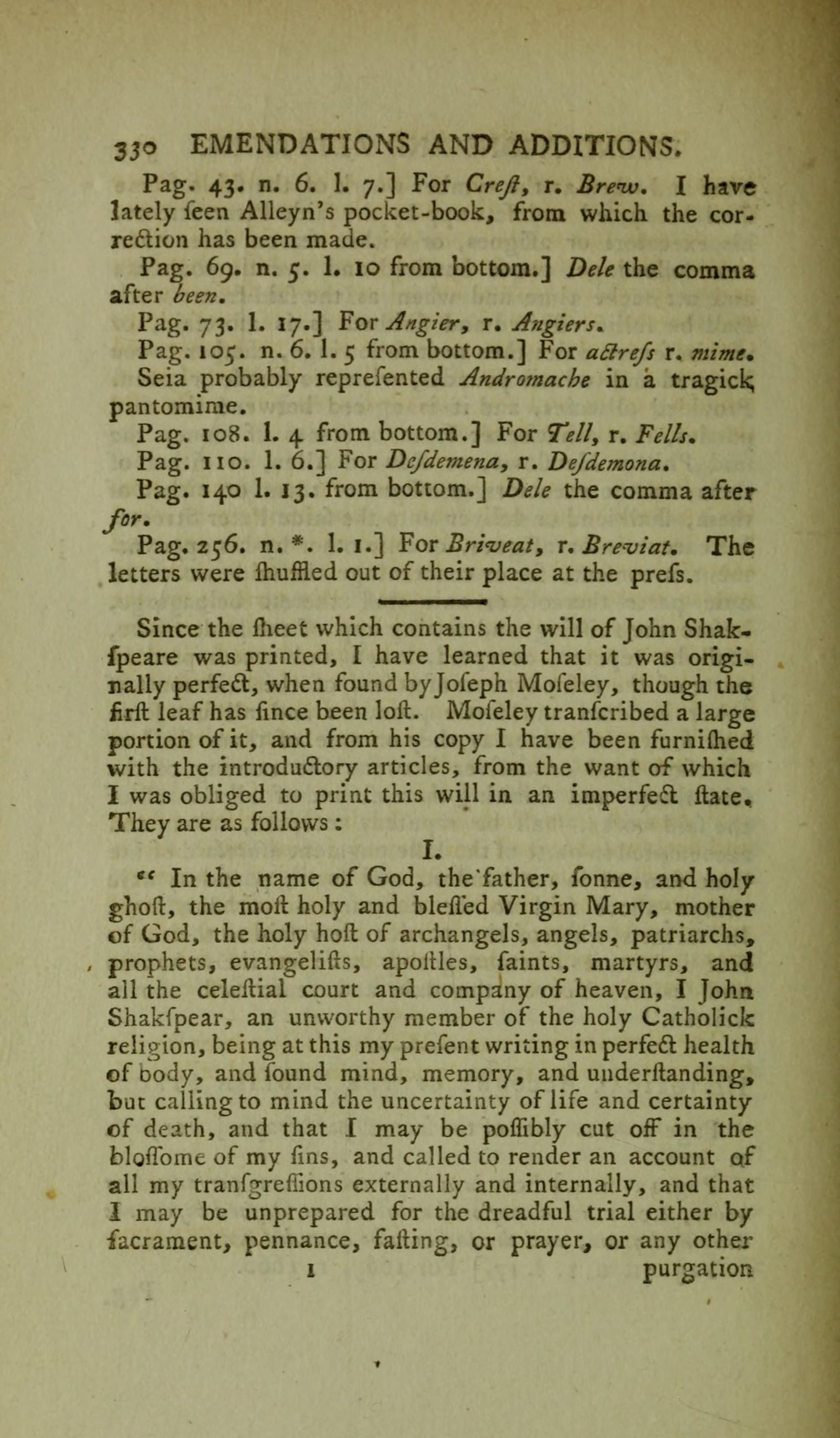
- The “blossom” line is on Jordan’s leaf. “Cut off in the blossom of my sins” sits in Article I, which belongs to the first leaf that John Jordan alone claimed to have copied and that Malone never saw. The Ghost’s line was in print from 1603, and Jordan knew the plays. The more probable direction of borrowing runs from Hamlet into Jordan’s leaf.
- Steggle is 2024, not 2025. Shakespeare Quarterly 75.1 (Spring 2024), pages 44 to 71, online March 2024. The 2025 date in circulation conflates it with his June 2025 “Good Mrs Shakspaire” letter finding and a late-2025 wave of recycled web stories.
- Malone’s retraction was about attribution, not forgery. In 1796 he wrote that documents proved the testament “could not have been the composition of any one of our poet’s family”. He never said it was forged. Boswell in 1821 could not find the documents and supposed Malone meant his discovery of a second John Shakespeare in Stratford, a shoemaker.
- 1757 is Jordan’s date. Malone’s own estimate placed the find around 1770, “about twenty years” before 1789.
- Thurston’s 1923 article was in The Dublin Review, not The Month. His 1911 article arguing authenticity was in The Month. The 1661 Mexico City edition he found is no longer the earliest witness; Steggle has traced the text to Venice, 1613, with the Borromeo attribution appearing only from 1635.
- The Portsmouth Institute symposium was 2011, not 2009. The 2009 symposium was on William F. Buckley Jr.
- Davies wrote after 1688, not around 1660. He inherited Fulman’s papers at Fulman’s death in 1688 and died in 1707 or 1708.
- “Shakespeare’s kinsman was executed in 1583” rests on a disputed pedigree. The kinship between Mary Arden of Wilmcote and Edward Arden of Park Hall is asserted without a documentary chain, and when the heralds drafted the Shakespeare arms in 1599 they first drew the Park Hall coat, then struck it out.
- John Cottom is not demonstrably in the Hoghton will. Full-text searches of the two public-domain printings of the will find no Cottom in it. Honigmann’s actual link is that the Cottoms were Hoghton neighbours at Tarnacre.
- The “October 1580 to July 1581” claim has no document behind it. The press claim that Hoghton family papers place a Shakeshafte at the house for those dates was not supported by any cited document. The will is the only record.
- Southwell was at Arundel House. He was chaplain to the Countess of Arundel in the Strand, not resident in Southampton’s household. The “Southampton House” placement was not found in any source.
- The Flower portrait is a nineteenth-century object. The National Portrait Gallery found chrome yellow, unavailable before about 1814, in its paint layer in 2005. Any argument built on it is dead.
Sources: Chambers 1930; princehamlet.com; Steggle 2024; Folger blog, December 2025; Boswell-Malone Variorum 1821; Bowden 1899; Portsmouth Institute; Shakespeare Documented, Henry Jackson letter (Fulman MS 304); Collins 1945; Shakespeare Documented, 1599 draft; Piccope 1860 (search); THE 1997; Wikipedia, Southwell; Wikipedia, Flower portrait.