The strongest honest case that the Shakespeares were Catholic, or Catholic-leaning. Built without the Spiritual Testament as John’s and without the 1592 return as proof of recusancy.
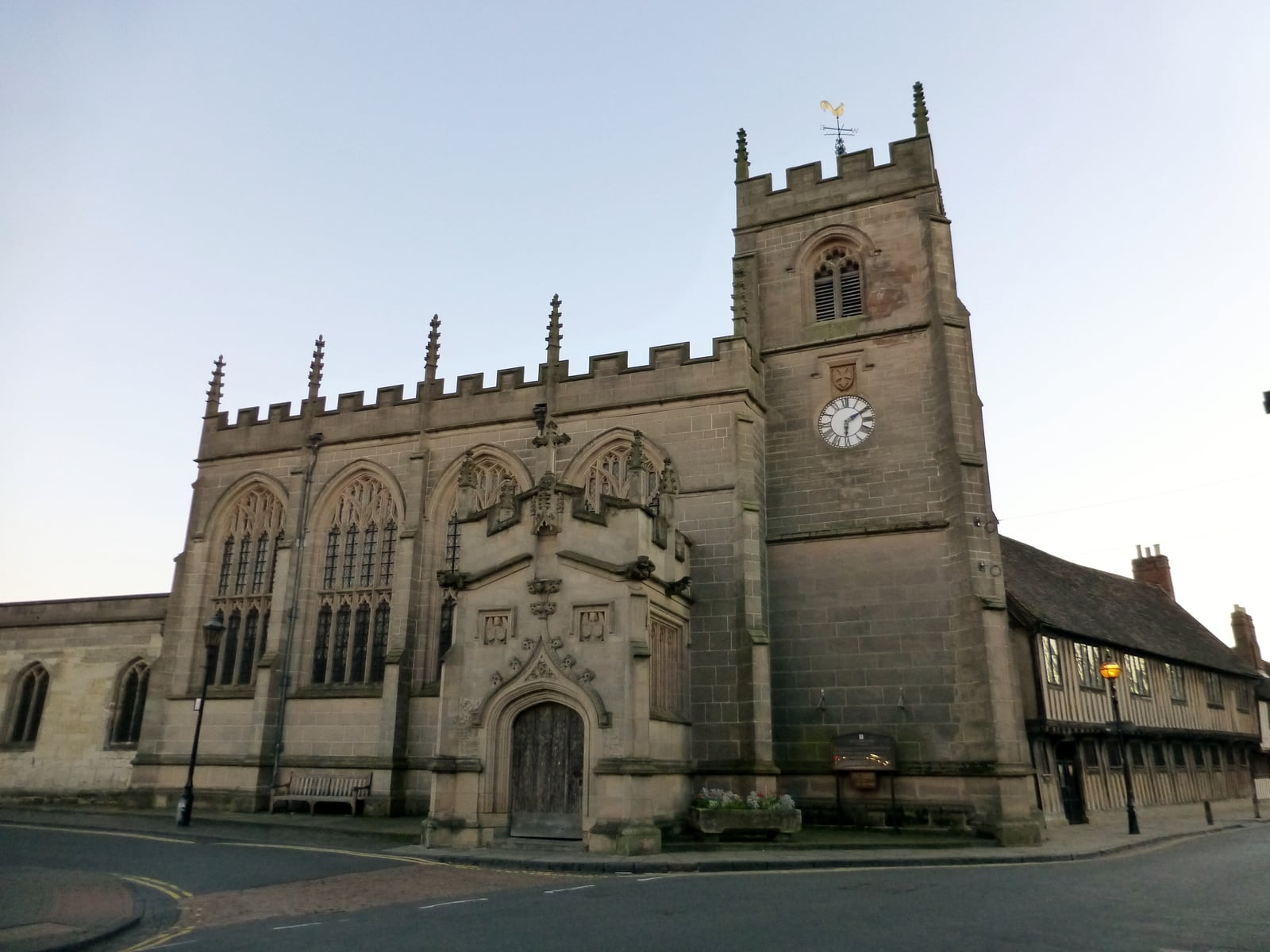
The Guild Chapel of the Holy Cross, Church Street, Stratford-upon-Avon, with the Guildhall and schoolroom range beyond the tower. John Shakespeare, as chamberlain, recorded the payment for limewashing its images in 1563/64.Rude Health, 2012-10-16. Wikimedia Commons. CC BY-SA 2.0.
1. The generation and the town
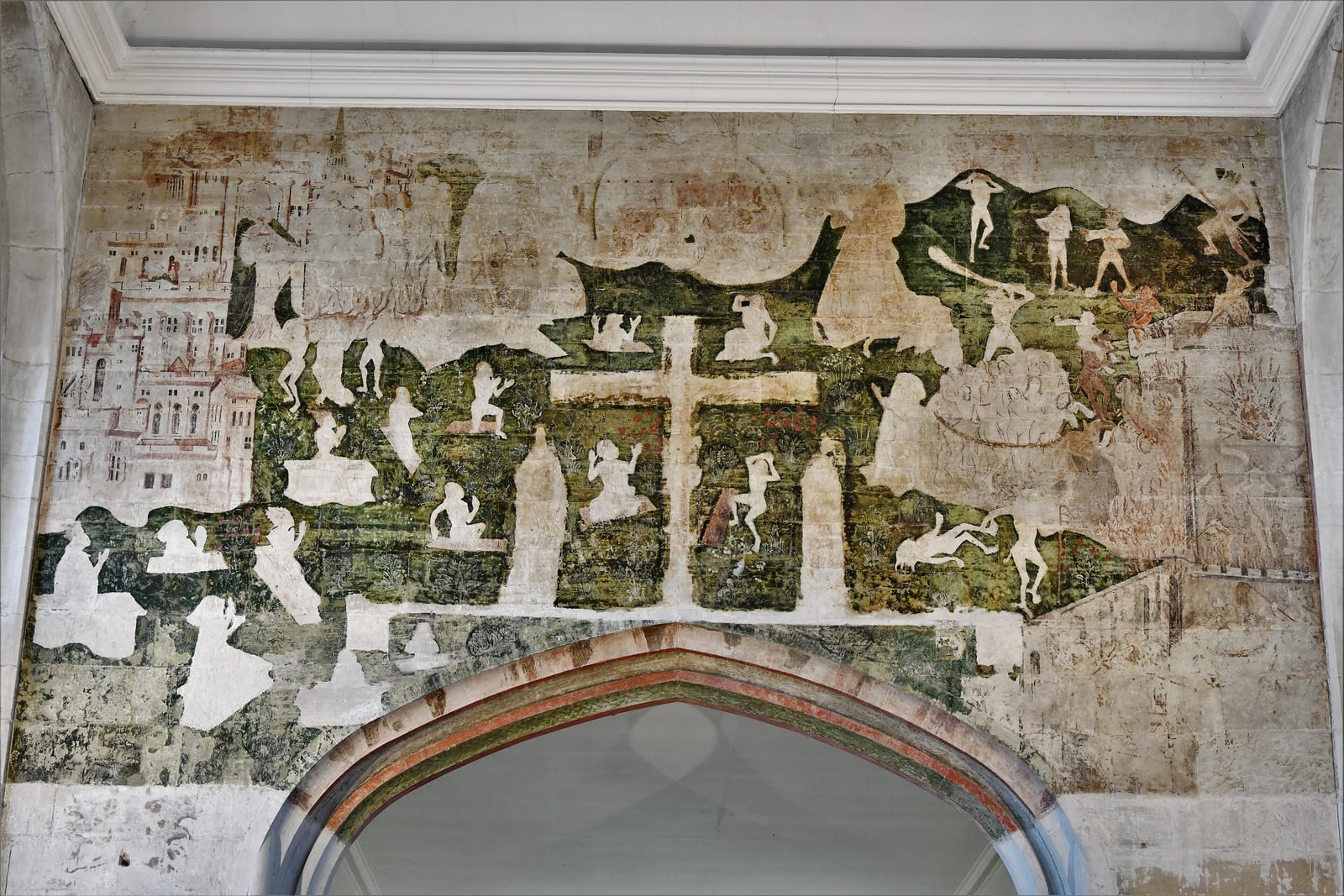
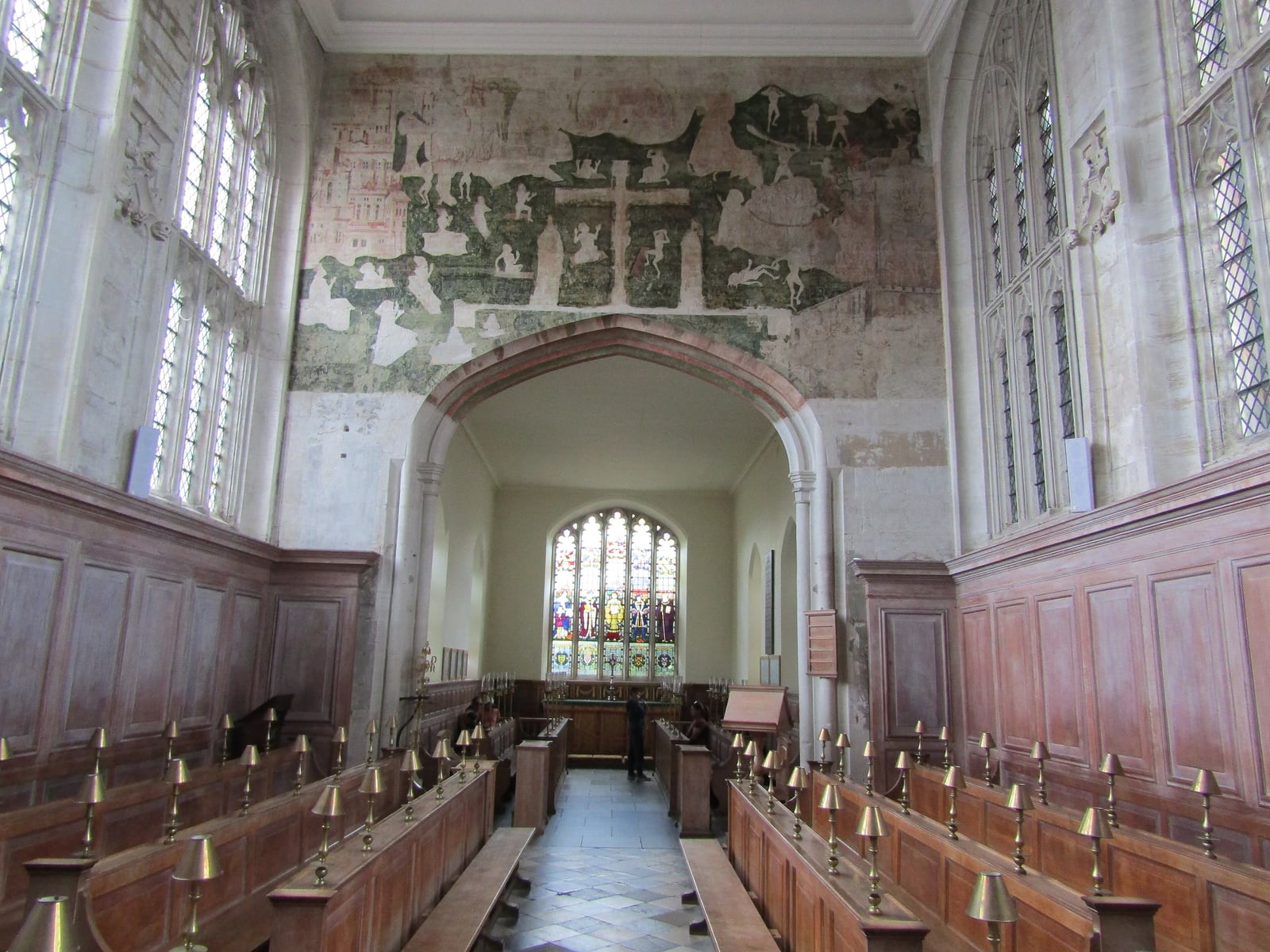
Every adult in Stratford in 1564 had been baptised a Catholic. The town kept its guild, its chapel and its Doom painting into the 1560s. The Guild Chapel images were not limewashed until 1563/64, sixteen years after the 1547 legislation. The payment was two shillings, which fits a thin coat of wash rather than destruction. The paintings came back to light in 1804.
John Shakespeare held office under Mary, when Protestants were kept out of such posts; Thurston made that point in 1912. Robert Arden, the maternal grandfather, joined the Guild of the Holy Cross in 1517, was prominent in the Aston Cantlow fraternity in 1538, and made a will in November 1556 whose preamble Sidney Lee called that of “an observant Catholic”.
None of this is unusual for the time. All of it means the household William was born into had the old religion in living memory, not as history.
The Doom over the chancel arch of the Guild Chapel, Stratford-upon-Avon: Christ enthroned, the dead rising, the damned driven toward hell. Limewashed in 1563/64, uncovered in 1804, conserved in 2016.Michael Garlick, 2022-06-15. Wikimedia Commons. CC BY-SA 2.0.Inside the Guild Chapel, looking east to the Doom above the chancel arch. The schoolroom is forty feet away.Colin Smith, 2023-07-29. Wikimedia Commons. CC BY-SA 2.0.
Solid↑ cuts for a Catholic milieu; neutral on belief
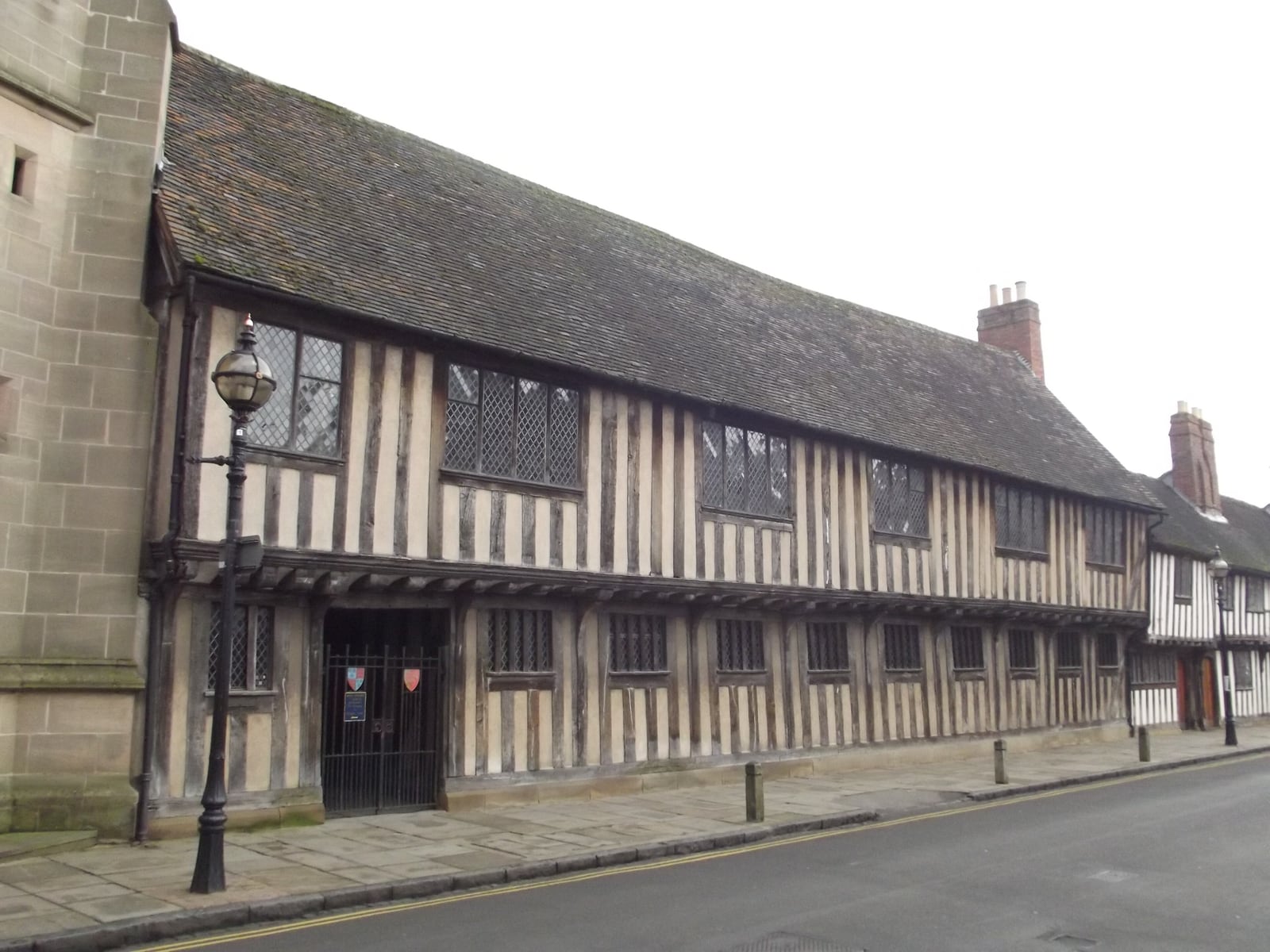
The Corporation on which John sat hired, in succession, Simon Hunt (1571 to 1575), who on one identification went to Douai and became a Jesuit; Thomas Jenkins (1575 to 1579), a St John’s Oxford man where Campion had been a fellow; and John Cottom (1579 to 1581/82), whose brother Thomas Cottam was arrested at Dover in 1580 carrying a letter to the Shottery family of Robert Dibdale, and was hanged with Campion’s companions on 30 May 1582. Winstanley’s 2017 article confirmed the Cottom and Cottam fraternity and accepted that this John was probably the Stratford master.
Dibdale himself came from Anne Hathaway’s hamlet. He became a priest, served as exorcist at Denham, and was executed at Tyburn on 8 October 1586. A Richard Dibdale was still listed as a “wilful recusant” in Stratford in 1592.
A boy at the King’s New School in the 1570s sat under men with live connections to the mission, and his future wife’s village sent a martyr to the gallows. No school records survive, so his attendance is inference.
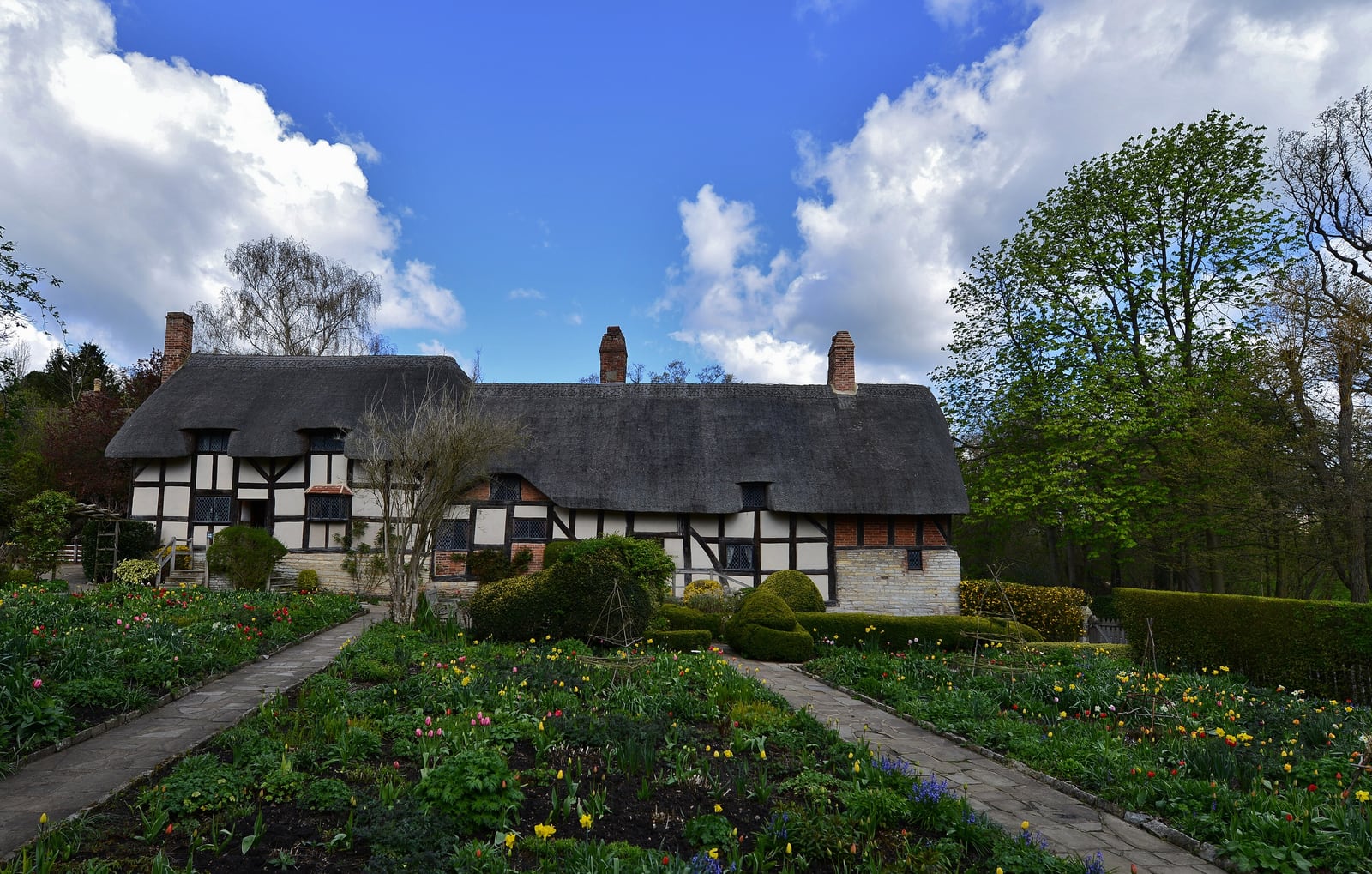
The Guildhall, Church Street, Stratford-upon-Avon. The schoolroom of the King’s New School was on the upper floor; Hunt, Jenkins and Cottom taught here. No school records survive.Elliott Brown, 2013-01-06. Wikimedia Commons. CC BY 2.0.Anne Hathaway’s Cottage at Shottery, the hamlet that was also Robert Dibdale’s. Dibdale was executed at Tyburn on 8 October 1586.Michael Garlick, 2016-04-28. Wikimedia Commons. CC BY-SA 2.0.
Solidtenures, fraternityDisputedHunt’s identity (two Simon Hunts)↑ weakly for a Catholic milieu
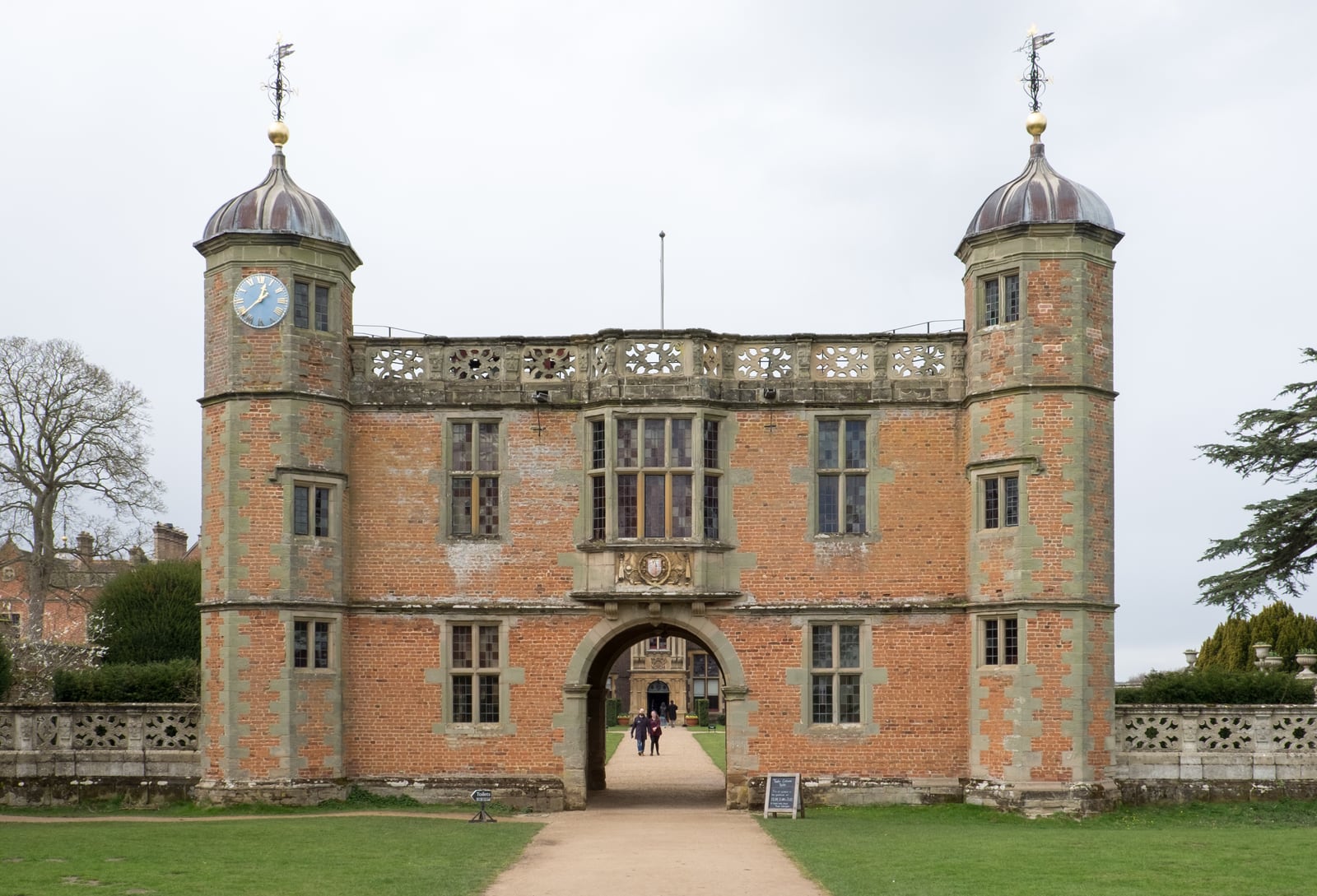
Whatever the exact pedigree, the Wilmcote Ardens claimed the Park Hall connection, and the heralds’ draft of 1599 shows the family asserting it. Edward Arden of Park Hall kept the priest Hugh Hall disguised as a gardener. He was hanged, drawn and quartered at Smithfield on 20 December 1583 on the word of a racked son-in-law, with Sir Thomas Lucy of Charlecote searching Arden houses. Parry and Enis note that the 1583 jury that indicted Arden “included men known to the Shakespeare family”. William was nineteen.
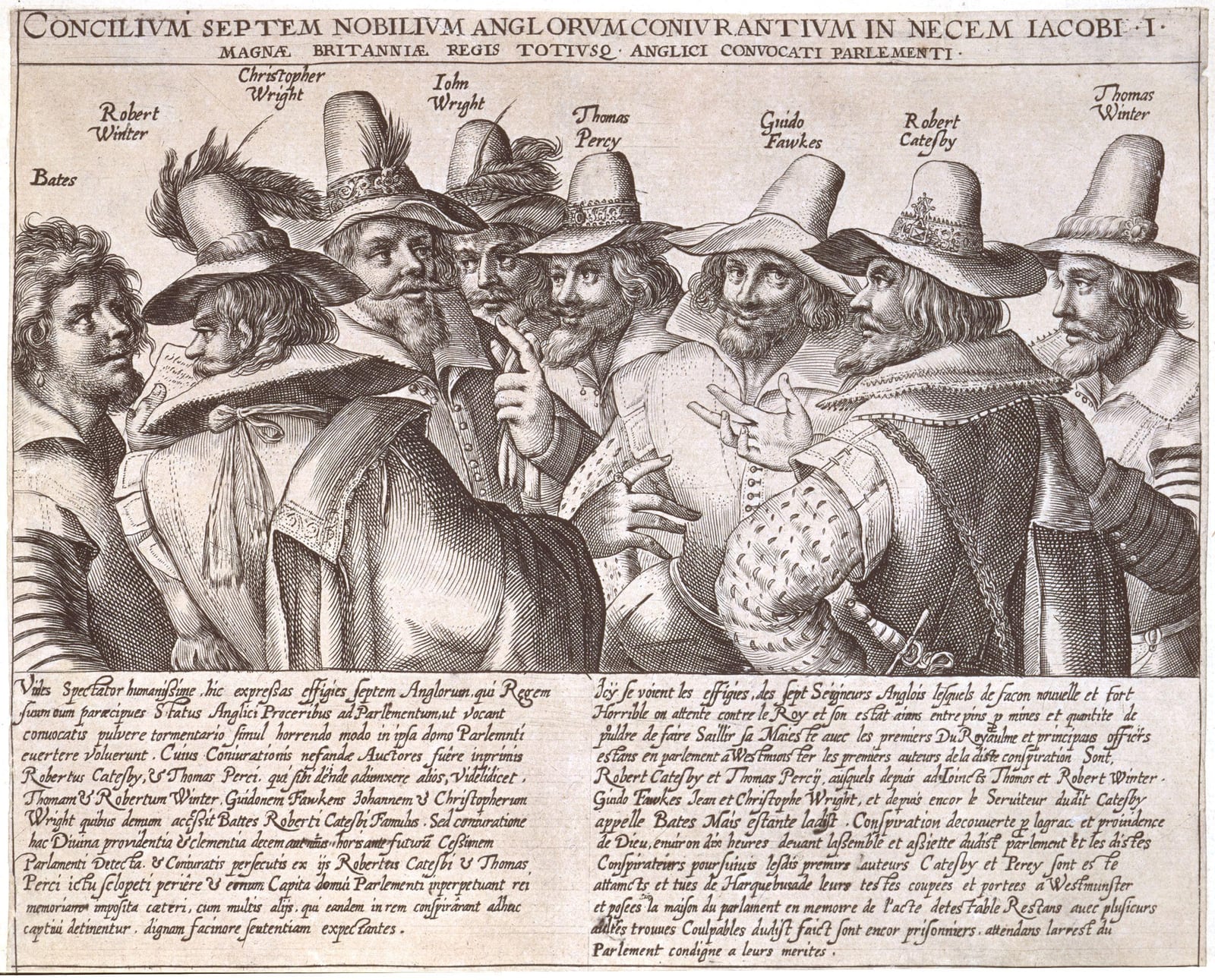
The Catesbys at Lapworth, twelve miles off, harboured Campion and were tried for it in Star Chamber in 1581. The Throckmortons at Coughton were fined and imprisoned. In 1605 the Gunpowder plotters rented Clopton House a mile from Stratford, kept arms at Norbrook near Snitterfield, and the Stratford authorities seized chalices and vestments from Clopton afterwards. At the January 1606 borough sessions fourteen people were listed as recusants.
This was not a Protestant market town with a few odd papists. It was the operational heartland of the Jesuit mission.
The Gunpowder plotters, engraved by Crispijn van de Passe the Elder, 1605: Bates, Robert Wintour, the Wrights, Percy, Fawkes, Catesby, Thomas Wintour.Crispijn van de Passe the Elder, 1605. Wikimedia Commons. Public domain.The gatehouse of Charlecote Park, Sir Thomas Lucy’s house. Lucy searched the Arden houses in 1583; the deer-poaching story in Davies’s note is set here.DeFacto, 2016-04-09. Wikimedia Commons. CC BY-SA 4.0.
Solidthe eventsDisputedthe Park Hall kinship↑ for a frightened Catholic Warwickshire; nothing on the Shakespeares by document
The twins’ godparents, Hamnet and Judith Sadler, were cited for recusancy in 1606. Shakespeare kept Hamnet Sadler as an intimate to the end: he interlined his name into the will for a mourning ring and had him witness it.
Susanna, aged 22 and living under her father’s roof at New Place, was cited on 5 May 1606 for failing to receive Easter communion, in the first Easter after the Gunpowder Plot, when the authorities were flushing out exactly this behaviour. William Reynolds, another ring legatee, was jailed in Warwick for recusancy in autumn 1613; his parents appear on recusancy lists.
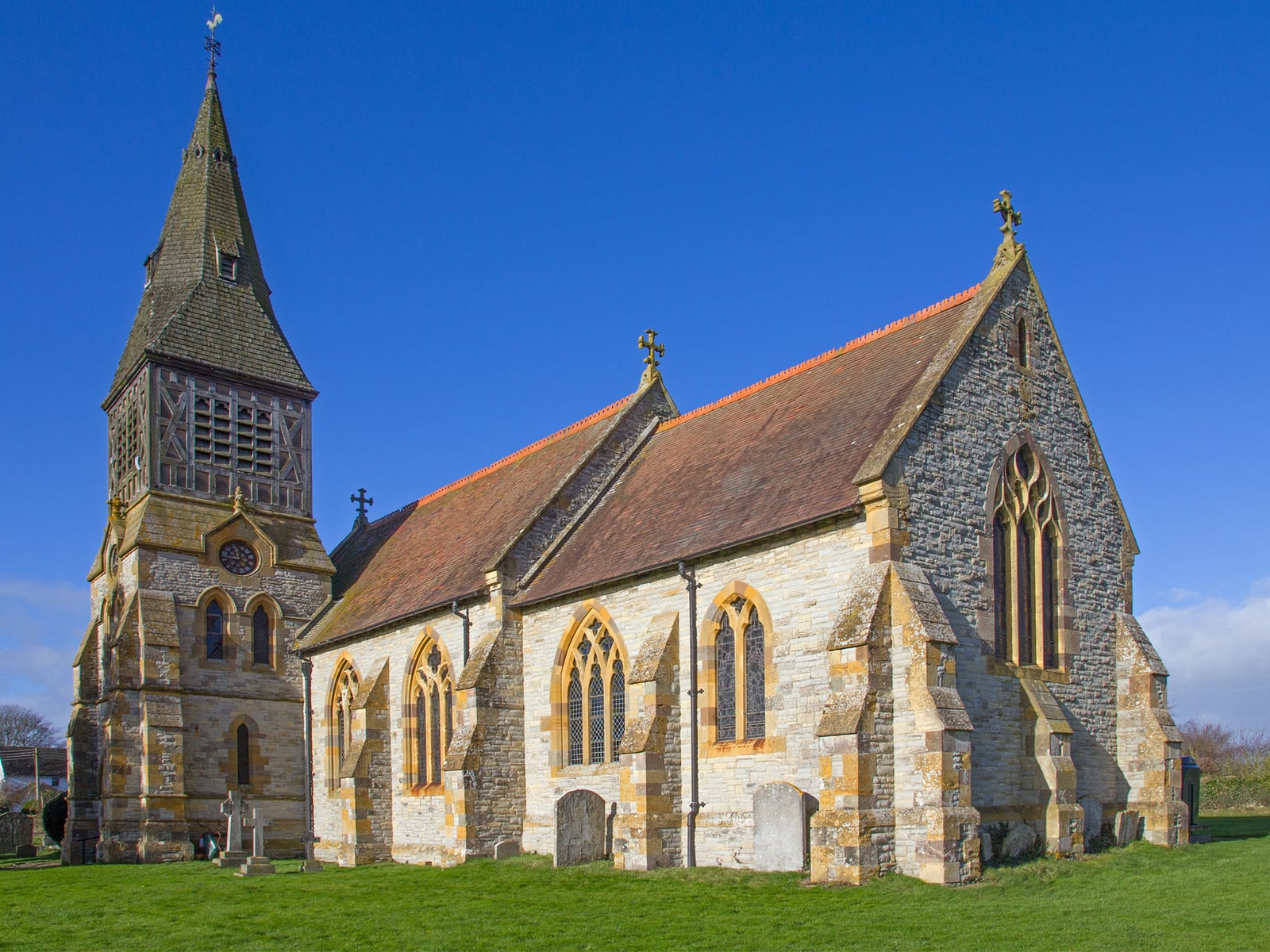
The marriage of 1582 was by licence for a single calling of banns at a church away from Stratford, probably Temple Grafton. A 1586 Puritan survey called its vicar John Frith “an old priest and unsound in religion”. John Shakespeare did not stand surety.
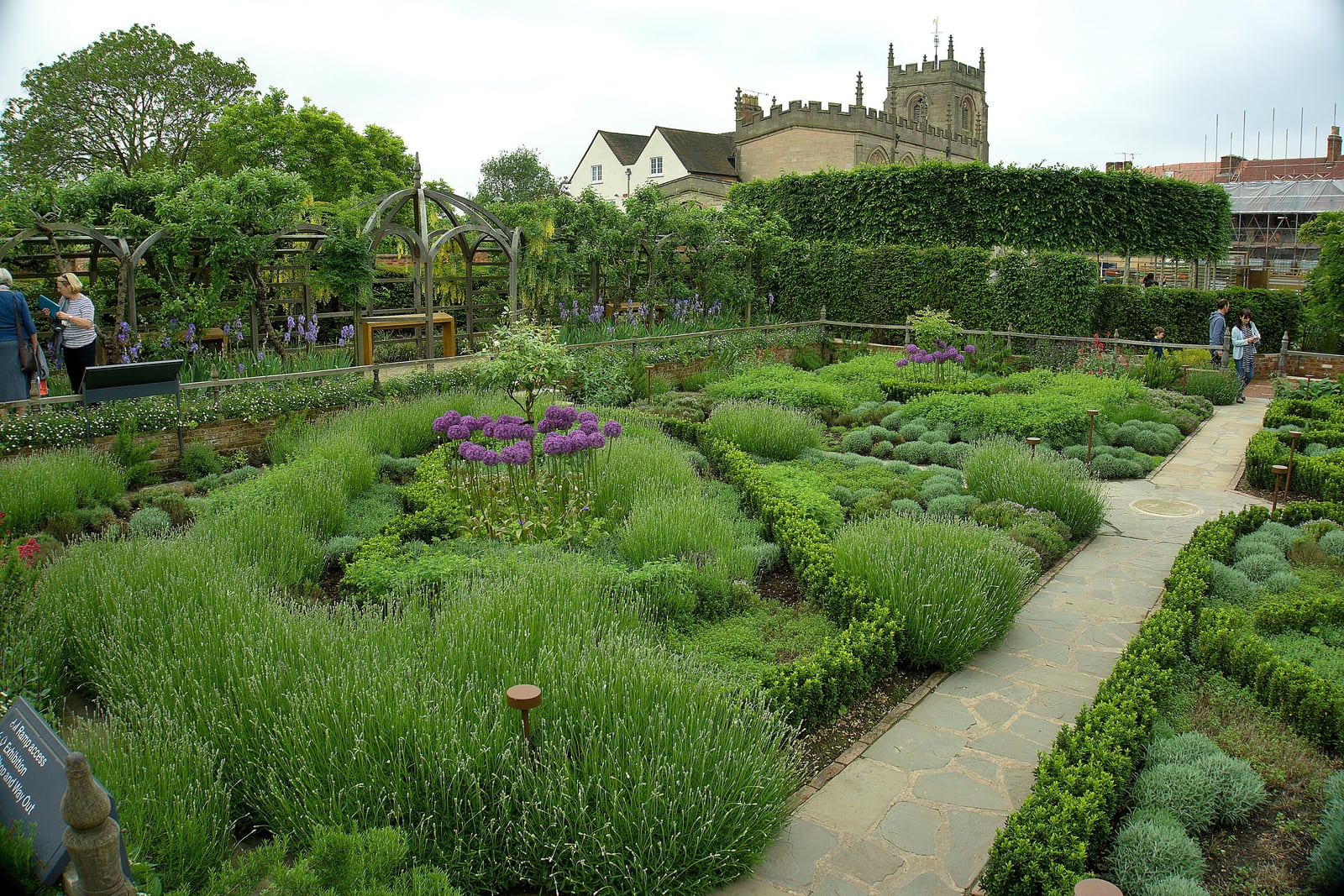
St Andrew’s, Temple Grafton, the probable church of the 1582 marriage, whose vicar John Frith was called an old priest and unsound in religion in 1586. The present building is an 1875 rebuild.David P Howard, 2013-01-31. Wikimedia Commons. CC BY-SA 2.0.The site of New Place today, with the Guild Chapel tower behind. Susanna was living here with her father when she was cited in May 1606.Noisar, 2018-05-29. Wikimedia Commons. CC BY-SA 2.0.
SolidSusanna 1606, the Sadlers 1606 (primary list not seen)Solidleaning: Reynolds jailed in 1613 (cited at second hand)Disputedthe marriage venue↑ weakly for
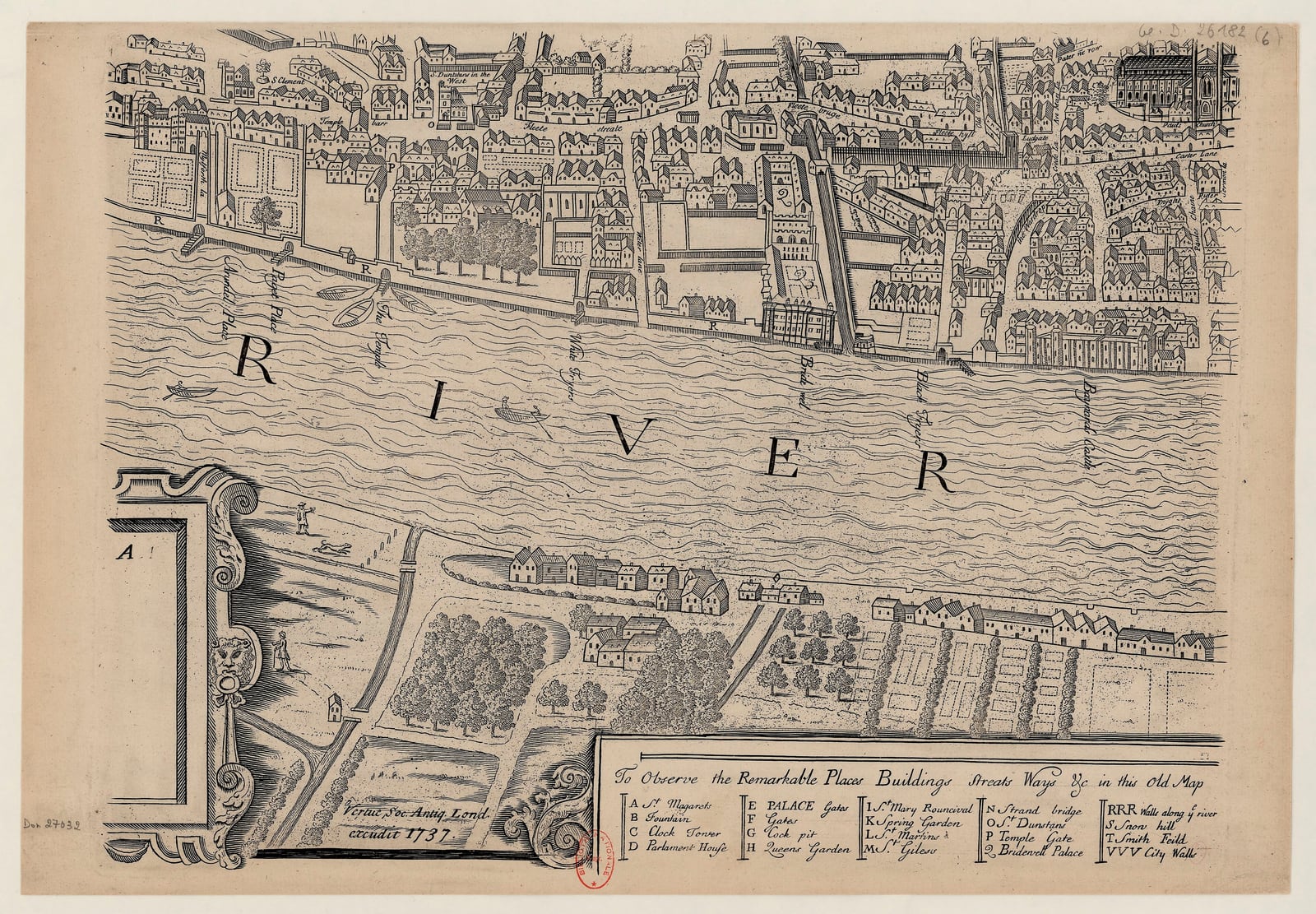
In March 1613 Shakespeare bought, as his only London property, the Blackfriars gatehouse that the State Papers had marked for a quarter-century as a nest of priests. It had been held under Mary by a Catholic bishop, tenanted by Southwell’s sister and a recusant judge’s widow, reported in 1586 to have “sundry backdoors and bye-ways, and many secret vaults and corners”, raided in 1598 with priests hidden inside, and used by the Jesuit John Gerard in 1605.
He kept or installed as tenant a John Robinson who shares a name with a recusant family whose son entered the English College at Rome that year. He left the house to Susanna, the daughter cited in 1606, with its tenant in place. Robinson witnessed the will. Susanna kept him as tenant to 1639.
Blackfriars on the Agas map, Civitas Londinum, about 1561, in George Vertue’s 1737 impression. Bibliothèque nationale de France.George Vertue, after the map attributed to Ralph Agas; scan by the Bibliothèque nationale de France, 1737 impression of a map of about 1561. Wikimedia Commons. Public domain.
Solidthe house’s history and the purchaseDisputedmotive; the Robinson identification↔ open
Richard Davies, a beneficed Anglican clergyman and later Archdeacon of Coventry, wrote privately in a scholarly collection after 1688, with no polemical motive, and recorded as plain fact: “He dyed a papist.” Thurston found no reason for Davies to misrepresent the matter and called the claim “by no means incredible”.
A deathbed reconciliation by a priest from the gentry network around Stratford is the kind of event that leaves no document and is remembered. It is the only direct testimony by anyone, in any century, that Shakespeare was a Catholic. Its source is unknown.
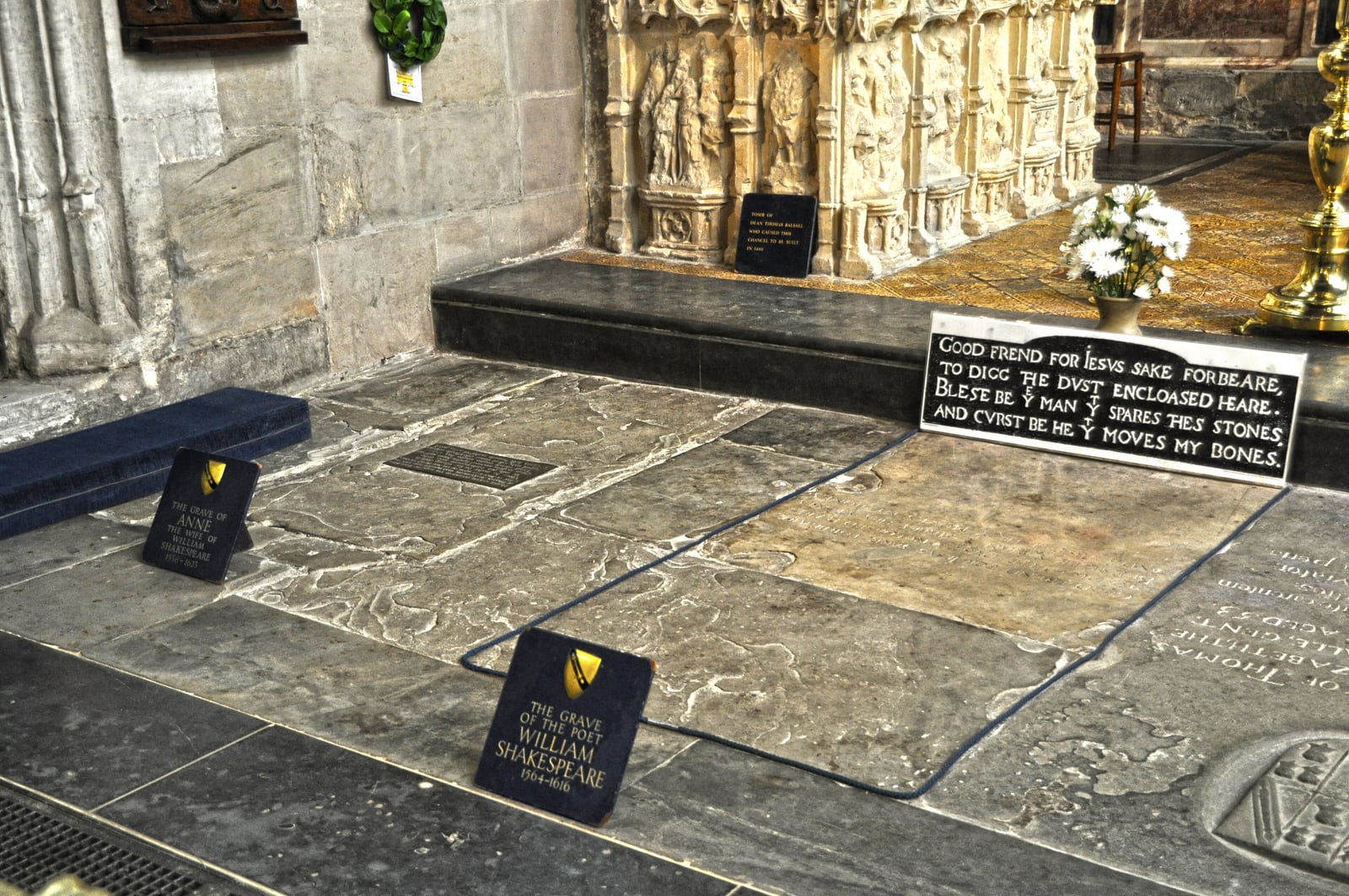
Shakespeare’s grave in the chancel of Holy Trinity, with the transcription of the four-line curse that Davies’s note mentions: Good frend for Iesvs sake forbeare.Lewis Clarke, 2014-05-04. Wikimedia Commons. CC BY-SA 2.0.
Solidas a documentDisputedas testimony↑ for, uncheckable
7. The plays, written from inside the old religion
Shakespeare writes the old religion from the inside, with a sympathy his sources did not require. His Ghost describes Purgatory in doctrinally exact terms and names the three deathbed rites the Church of England had abolished. His friars, abbesses and hermits are benign where Brooke’s preface calls friars “instruments of unchastity”. He added a Poor Clare novice and three auricular confessions to a story that had none.
He cut the crude anti-Catholic comedy from his King John source and never staged a corrupt Mass. He mocked a Puritan in Malvolio and a hedge-priest in Martext and never mocked a sacrament. The Winter’s Tale stages an image in a chapel doing what Protestant polemic said images could not. Beauregard counts nineteen “do penance” phrases where Protestant Bibles read “repent”, and about fifteen references to auricular confession. The count is tentative.
The detail is graded play by play below.
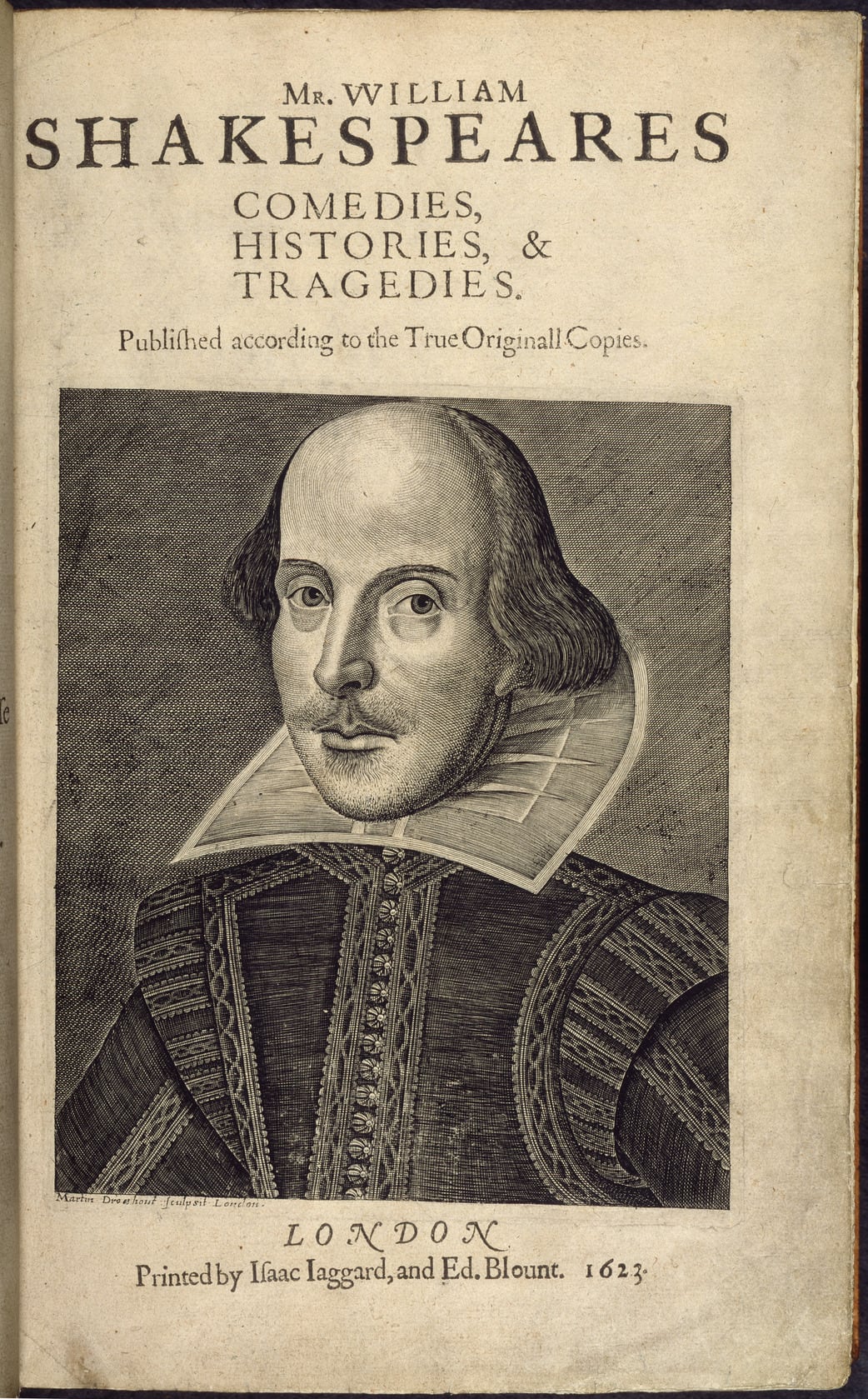
The First Folio title page, 1623. British Library copy.Isaac Jaggard and Edward Blount, printers; Martin Droeshout, engraver; scan by the British Library, 1623. Wikimedia Commons. CC0.
StrongHamlet’s Purgatory, as dramatic sympathySuggestivethe friars, Measure for Measure, King John’s cuts, the statue↑ for sympathy, not for belief
If the Spiritual Testament is Joan Hart’s, as Steggle argues, then a member of the Shakespeare household, living as a widow in the western Henley Street cottage between 1616 and 1646, possessed a Catholic will of the soul and meant, in the Bristol release’s words, to die “a good Catholic death”.
Pearce’s reply, that this only shows Joan shared her father’s Catholic faith, overreaches. It proves nothing about the father. It does leave a Catholic in the house that William grew up in and owned.
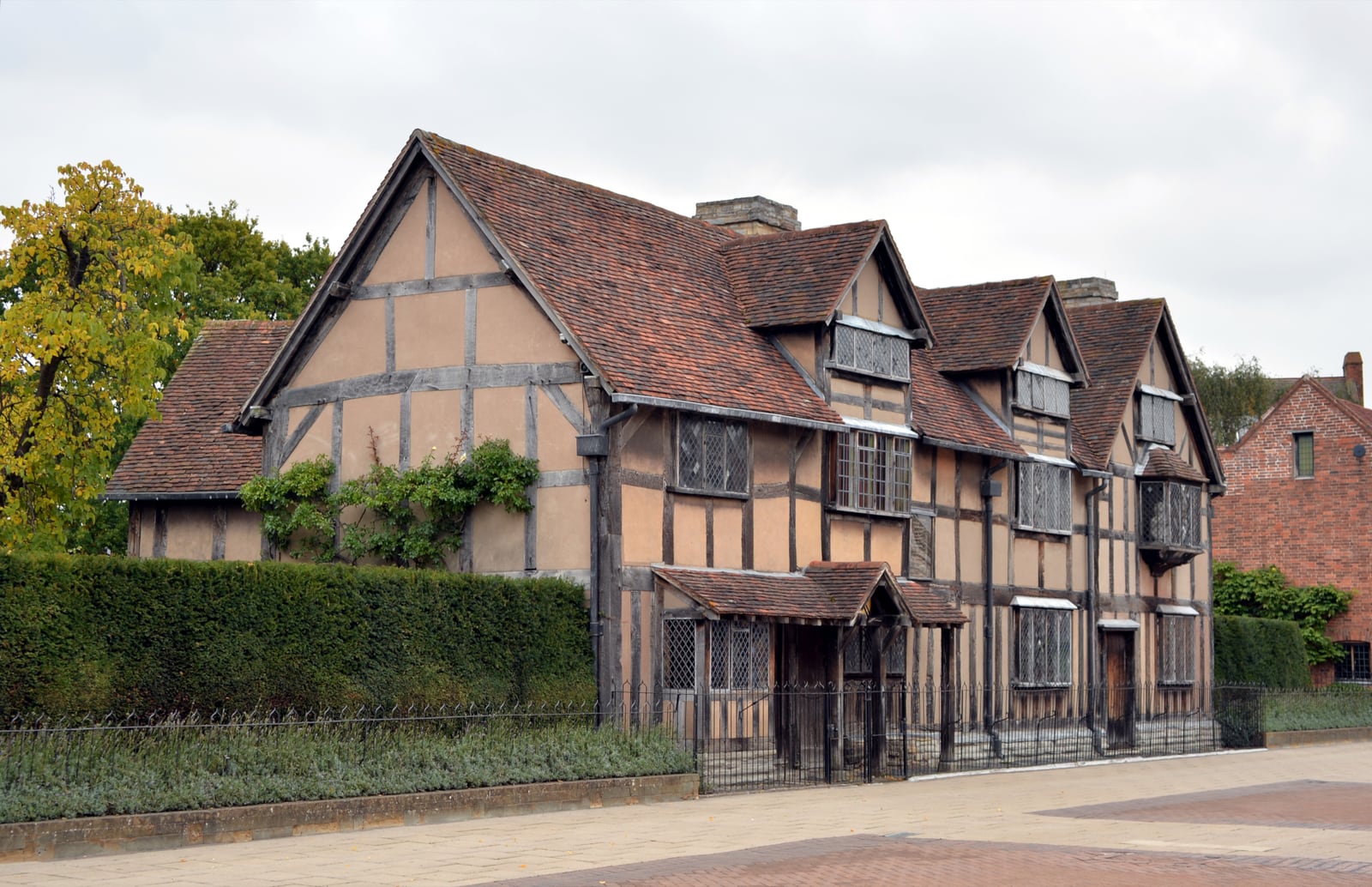
The Birthplace, Henley Street, Stratford-upon-Avon. The lower cottage at the left is the western house where Joan Hart lived as a widow from 1616 to 1646 and where the Testament was found in the roof. The frontage is the 1857 to 1864 restoration.habiloid, 2015-10-17. Wikimedia Commons. CC BY-SA 2.0.
DisputedSteggle’s hypothesis; no refereed rebuttal found between mid-2025 and October 2026↑ weakly for a Catholic household in the Birthplace, not for William’s upbringing
9. The scholars who hold the Catholic-formation view
Honigmann’s mature position was that Shakespeare was probably brought up Catholic, possibly stayed Catholic underground for a time, probably conformed when his theatre career began, and possibly returned at death. Alison Shell, who argues more carefully than anyone that the plays cannot be read as confession, still accepts that the external evidence points to a Catholic who sacrificed theological coherence for “imaginative amplitude”.
Dennis Taylor’s 2023 book states that “most scholars now agree” he was likely raised Catholic. Rowan Williams said at Hay in 2011 that Shakespeare “probably had a Catholic background”; McCoog notes that Williams did not call him a recusant. Gary Taylor’s 1994 essay argued outright for a recusant Shakespeare, and stands unrepeated rather than refuted.
Solidthat these positions are held↑ for a Catholic upbringing; split on the adult
That is the strongest honest case. It establishes a Catholic formation, a Catholic-dense world, a household and friendship circle with several documented non-conformists, one ambiguous property purchase, one late unsourced report of a Catholic death, and a body of work that treats the old religion with knowledge and tenderness. It does not establish that William Shakespeare ever heard Mass as an adult, ever refused communion, or ever believed what the Ghost says.