The Fight
The debate, from a parson’s jotting to a 2024 reattribution.
- c. 1690
Richard Davies fills Fulman’s blank Shakespeare entry: “He dyed a papist.”
- 1790 and 1796
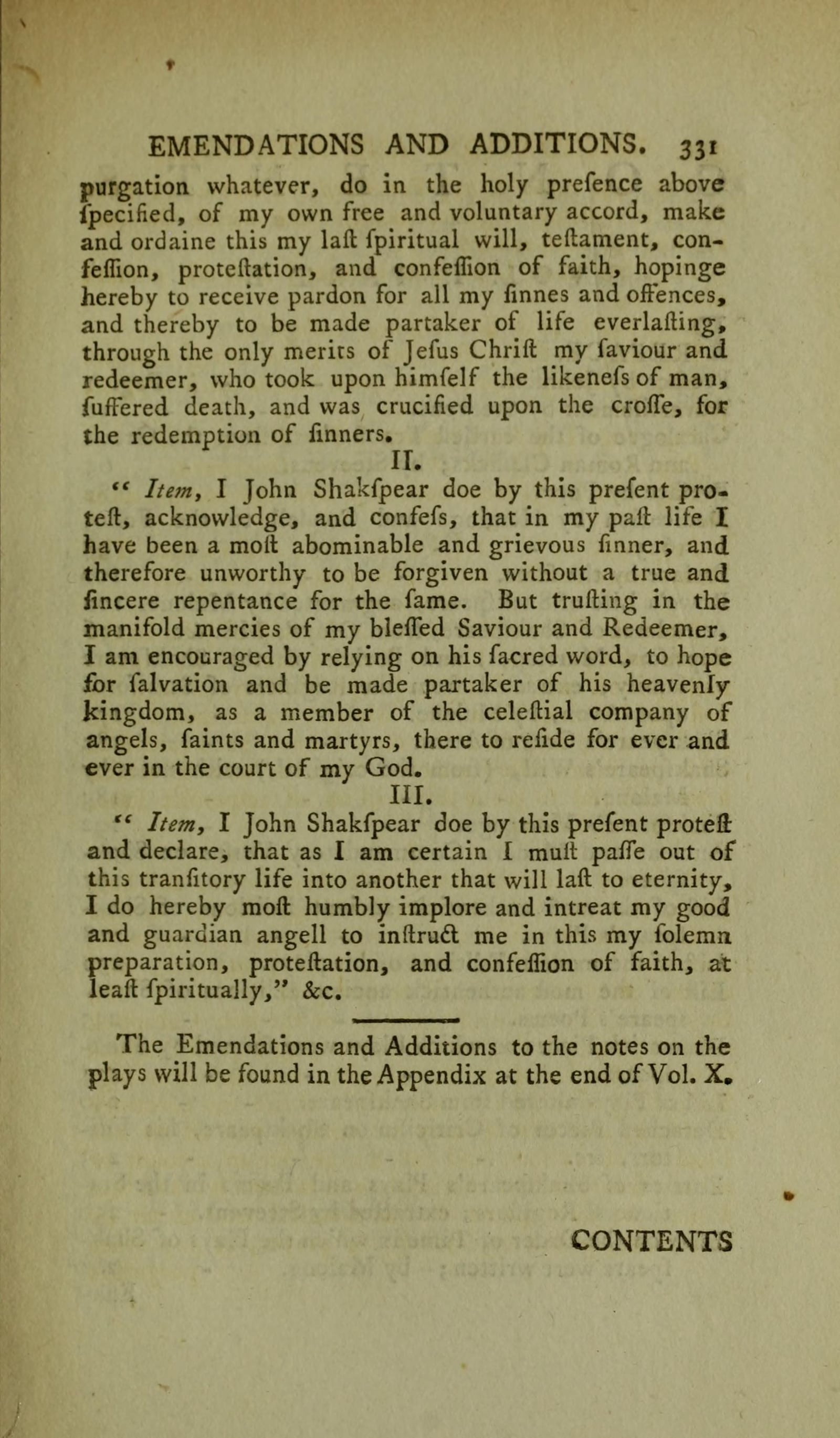
Malone prints the Spiritual Testament, “perfectly satisfied”; six years later he writes that documents prove it “could not have been the composition of any one of our poet’s family”. The documents were never produced.
- 1854
Richard Simpson, an Anglican vicar turned Catholic, publishes the first serious article in The Rambler, already complaining that Malone, “a Protestant critic”, had rejected the testament.
- 1899
Henry Sebastian Bowden packages Simpson’s materials as The Religion of Shakespeare.
- 1912 and 1923
Herbert Thurston SJ, in the Catholic Encyclopedia, judges that Simpson and Bowden “press the evidence for Catholicism too hard” and that the question “must remain forever uncertain”. In 1923, in The Dublin Review, he identifies the Testament’s body as a printed Catholic formulary from a Mexico City edition of 1661.
- 1946 and 1952
De Groot’s The Shakespeares and “The Old Faith”; Mutschmann and Wentersdorf’s Shakespeare and Catholicism.
- 1973 onward
Peter Milward SJ makes the thesis a life’s work from Sophia University, Tokyo. Knapp: his work has had “little influence on recent Shakespeare scholarship”. Milward himself: “the academic world is not disposed to accept it”.
- 1985
Honigmann’s Shakespeare: the ‘lost years’, the first non-confessional scholar to take the Lancashire theory seriously. Eric Sams in the Sunday Times calls the links “strongly suggestive” but finds the claims often overstated.
- 1994
Gary Taylor’s “Forms of Opposition” argues outright for a recusant Shakespeare: the high-water mark of academic confidence, later unrepeated rather than refuted.
- 1997 and 1999
Richard Wilson’s TLS essay “Shakespeare and the Jesuits”; the Lancaster and Hoghton Tower conference, with two Manchester volumes in 2003 and plans for an 800-seat theatre never built.
- 2001 and 2004
Greenblatt’s Hamlet in Purgatory and Will in the World put “Catholic Shakespeare” before more readers than any academic book, while the author declines to make him one.
- 2002 to 2008
Bearman’s archival work: Shakeshafte (2002), the Testament (2003), “A Papist or Just Penniless?” (2005) and Stratford’s Reformation (2007). In 2007 he wrote that the Lancashire, Testament and Cottom claims “rest on evidence which does not bear scrutiny”. In June 2008 he led a Birthplace Trust study day to test them.
- 2003
Michael Wood’s BBC series In Search of Shakespeare makes the Catholic family the spine of a biography and treats the Testament as Campion-linked key evidence. SHAKSPER posters call that handling “a disgrace”; Gary Taylor writes a hostile Guardian review.
- 2005
Clare Asquith’s Shadowplay: “high” and “low” mean Catholic and Protestant altars, priests are “merchants”. Anne Barton: clever but “far-fetched”. Shapiro: “specious” and unfalsifiable.
- 2008 and 2009
Joseph Pearce’s The Quest for Shakespeare and his thirteen-part EWTN series. Miola, a Catholic scholar: “a patchwork of other people’s work”. John Cox: “the argument fails to persuade”.
- 2010
Alison Shell’s Shakespeare and Religion: religion yields to the needs of the play, yet the external evidence points to a Catholic.
- 2011
The Portsmouth Institute symposium “The Catholic Shakespeare?” gathers the advocates with the in-house critic Cox. Rowan Williams at Hay: Shakespeare’s background was probably Catholic.
- 2014
Kastan’s A Will to Believe: “I don’t know what he believed and I am convinced we can’t know.” Pressed to guess, he picks a conforming parishioner.
- 2021
Lena Cowen Orlin’s The Private Life of William Shakespeare rereads the 1592 list and John’s collapse as a business story.
- 2024
Matthew Steggle, Shakespeare Quarterly 75.1: the Testament’s text dates from 1613 at the earliest and the Stratford copy is probably Joan Hart’s. Pearce replies in April; no refereed rebuttal found between mid-2025 and October 2026.
- 2025
Torevell, Schneeberger and Luke Taylor SJ’s Exploring Catholic Faith in Shakespearean Drama brackets whether Shakespeare was Catholic and argues the plays explore Catholic understandings “dramatically rather than didactically”. Ben Faber notes one of 69 seminars at the 2025 Shakespeare Association of America addressed religion.
Sources: The Rambler 1854 (EWTN); Catholic Encyclopedia 1912; Wikipedia, Milward; Sams 1985; SHAKSPER 2001 on Taylor; Wilson, TLS 1997; Wikipedia, Greenblatt; SHAKSPER, 2008 study day; SHAKSPER on Wood 2003; NYRB letters 2006; Miola on Pearce; Cox 2009; Church Times on Shell; Portsmouth Institute; THE on Kastan; OUP blog, Orlin; Steggle 2024; Liverpool Hope 2025; Faber 2025.
Why it was resisted in the Protestant era
From Malone onward Shakespeare was the national poet of a Protestant nation. Boswell in 1821 called it highly improbable that a Bailiff of Stratford was a Roman Catholic. Carlyle in 1840 made him “King Shakespeare” and a “rallying sign”. A Catholic Shakespeare was an awkward fit for Victorian bardolatry, and the thesis was being pressed by converts with an obvious stake, which let Protestant scholars treat it as advocacy. Sillars adds that biographers eager for a national genius, and Catholic historians eager to downplay international dimensions, both obscured the political evidence.
Sources: Boswell-Malone Variorum 1821; Wikipedia, Bardolatry; Sillars, NJES 2005.
Why it is resisted in the secular era
The Catholic side’s charge: Milward said scholars were held back by ecumenical tact and a “hostile secular mindset”. Asquith: “They don’t want him to be Christian.” Pearce says the Bard is under siege from atheists and “new heathens”. There is something in it. America magazine reported in 2009 that “most academics today hold that Shakespeare had no religion”, and Faber documents how marginal religion remains in the discipline.
The record supports the other charge at least as well. The academy’s resistance has been mostly methodological, not confessional. The coded-plays reading shares its central vulnerability with the authorship conspiracies: it treats absence of evidence as proof of concealment and dismisses objections as ignorance of the code. Kastan points out that a Catholic Shakespeare would be more useful to modern readers than the Anglican one long used to uphold Church of England norms, which undercuts the claim that the secular academy wants an unbelieving Bard.
Sources: NCRegister 2011; Imaginative Conservative 2025; America 2009; Faber 2025; Shapiro via Banner of Truth; THE on Kastan.
The sharpest critics of the Catholic case have been Catholics.
Thurston in 1912, who rated the claim unproven in the Church’s own reference work. Miola in 2008, who said Pearce’s book was assembled from other writers’ work. Cox in 2009. McCoog SJ in 2011, who showed that Hammerschmidt-Hummel’s Rome pilgrim-register entries referred to other men. Jeff Mirus, who warned against claiming great figures as “just like us”. Miola’s formulation is the fairest: Shakespeare is claimable by everyone because, unlike Dante, Spenser and Milton, he left no clear view into his soul.
Sources: Catholic Encyclopedia 1912; First Things, Miola 2008; Cox 2009; Thinking Faith 2011; Catholic Culture 2008.