The baseline: Shakespeare writes the old religion from the inside with a sympathy his sources did not require, reads his Bible in Protestant English, mocks a Jesuit when the court expects it, and never stages a Mass or a Marian devotion.
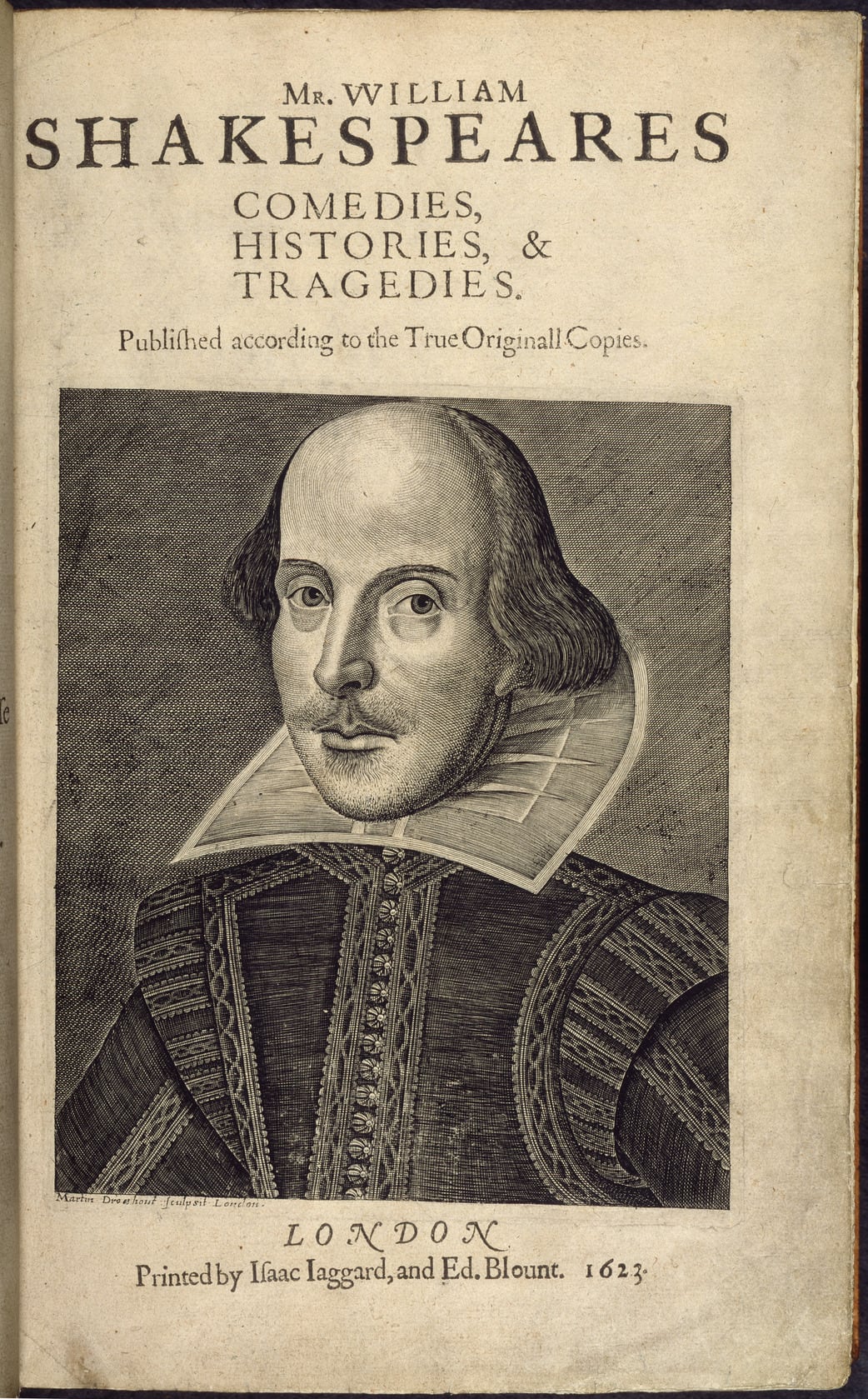
The First Folio title page, 1623. British Library copy.Isaac Jaggard and Edward Blount, printers; Martin Droeshout, engraver; scan by the British Library, 1623. Wikimedia Commons. CC0.
Hamlet and Purgatory
“I am thy father’s spirit, / Doomed for a certain term to walk the night / And for the day confined to fast in fires / Till the foul crimes done in my days of nature / Are burnt and purged away.” Hamlet 1.5
“Cut off, even in the blossoms of my sin, / Unhouseled, disappointed, unaneled, / No reck’ning made, but sent to my account / With all my imperfections on my head.” Hamlet 1.5
The three words name the three Catholic rites of the deathbed.
Unhouseled: without the housel, the Eucharist given as viaticum.
Disappointed: unprepared, without confession and penance.
Unaneled: without anointing, extreme unction.
The Church of England’s Article XXII called “the Romish Doctrine concerning Purgatory” a “fond thing, vainly invented”. Article XXV denied extreme unction the status of a sacrament. Prayers for the dead were cut from the 1552 Prayer Book. The 1547 Chantries Act ended 2,374 chantries and guild chapels. A 1601 audience could not hear “unhouseled, disappointed, unaneled” without hearing the old religion.
Hamlet swears “by Saint Patrick” (1.5), the patron of the legendary entrance to Purgatory on Lough Derg. The Ghost’s last words are “Adieu, adieu, adieu. Remember me.” Ophelia is buried with “maimed rites” and a Doctor of Divinity who refuses “To sing a requiem” (5.1).
What is inherited and what is his: an Ur-Hamlet existed by 1589 with a ghost crying “Hamlet, revenge!” like an oyster-wife, in Lodge’s phrase. Saxo and Belleforest supply feigned madness, a hasty remarriage and a killed spy, not Purgatory. The ghost is inherited. The theology, so far as the record allows, is Shakespeare’s choice.
The same play frames that doctrine inside a Protestant epistemology. Hamlet is a Wittenberg student. He tests the Ghost by Lavater’s criteria: “Be thou a spirit of health or goblin damned” (1.4); “The spirit that I have seen / May be a devil” (2.2). He trusts it only after the play within the play confirms it. Lavater’s Of Ghostes and Spirites (English 1572) held that the dead never return and that apparitions are angels, devils or delusions. Kastan’s point is fair: no character says Purgatory is real; the Ghost says it, and the Ghost is a character. Horatio’s “edified by the margent” (5.2) alludes to the Geneva Bible’s marginal notes.
Greenblatt’s Hamlet in Purgatory (2001) argues that the Protestant abolition of Purgatory destroyed the Church’s way of negotiating with the dead but not the longings behind it, and that Shakespeare turned those longings into the substance of the play. Greenblatt declines to call Shakespeare a secret Catholic.
The “blossom of my sins” link to the Spiritual Testament, formerly a key piece of evidence, is now weak and probably runs the other way: the phrase sits on Jordan’s leaf, Hamlet was in print from 1603, and Jordan knew the plays.
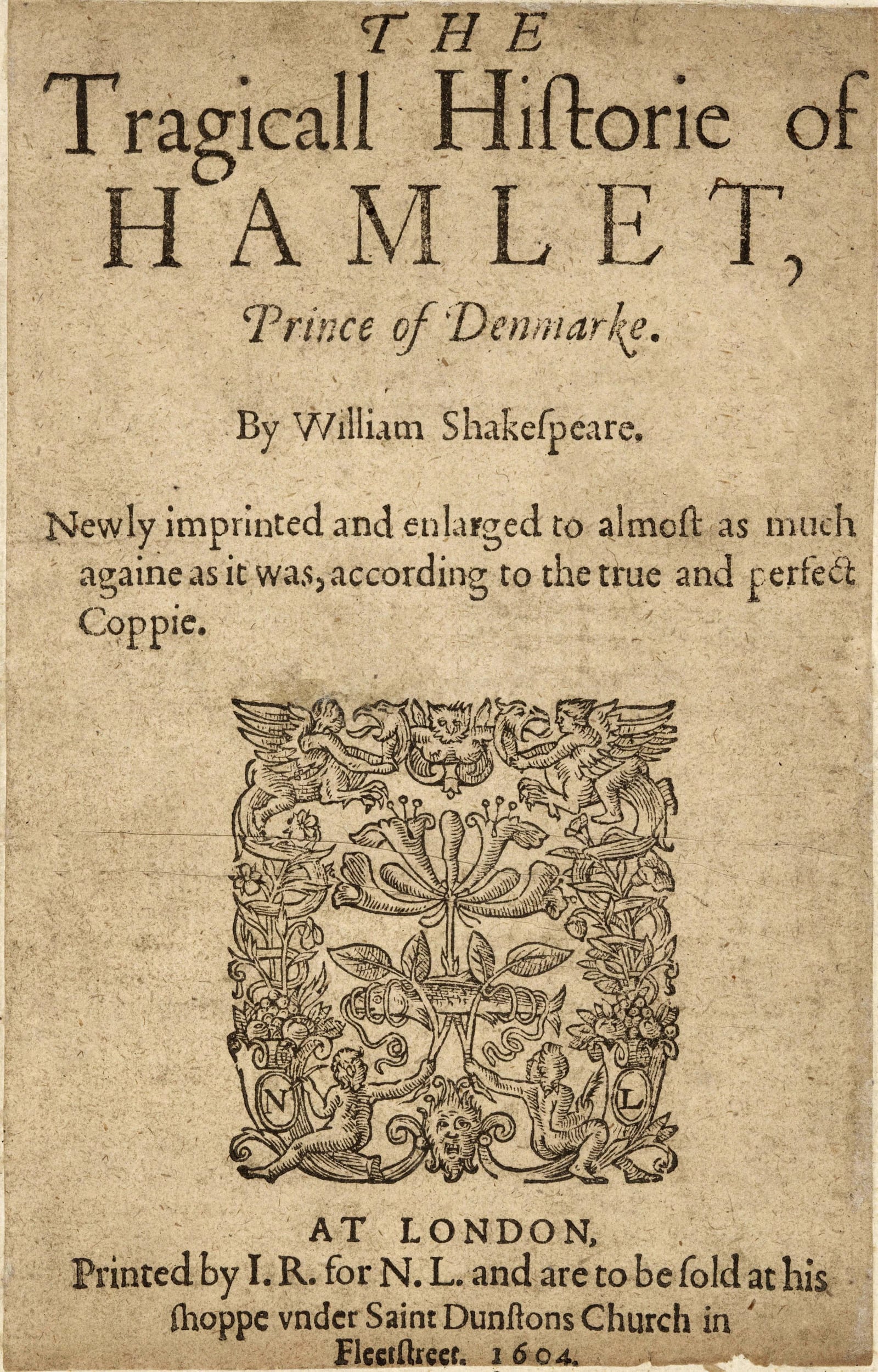
Hamlet, the Second Quarto, 1604. The Ghost’s lines were in print from 1603.Printed by James Roberts for Nicholas Ling, 1604. Wikimedia Commons. Public domain.
StrongPurgatory and the last rites, as sympathetic dramatic use of banned doctrineSuggestivefor belief; “Remember me”, Saint Patrick, the maimed ritesNeutralWittenberg and the devil test, cutting both ways
“Faith, here’s an equivocator that could swear in both the scales against either scale, who committed treason enough for God’s sake yet could not equivocate to heaven. O, come in, equivocator.”The Porter, 2.3
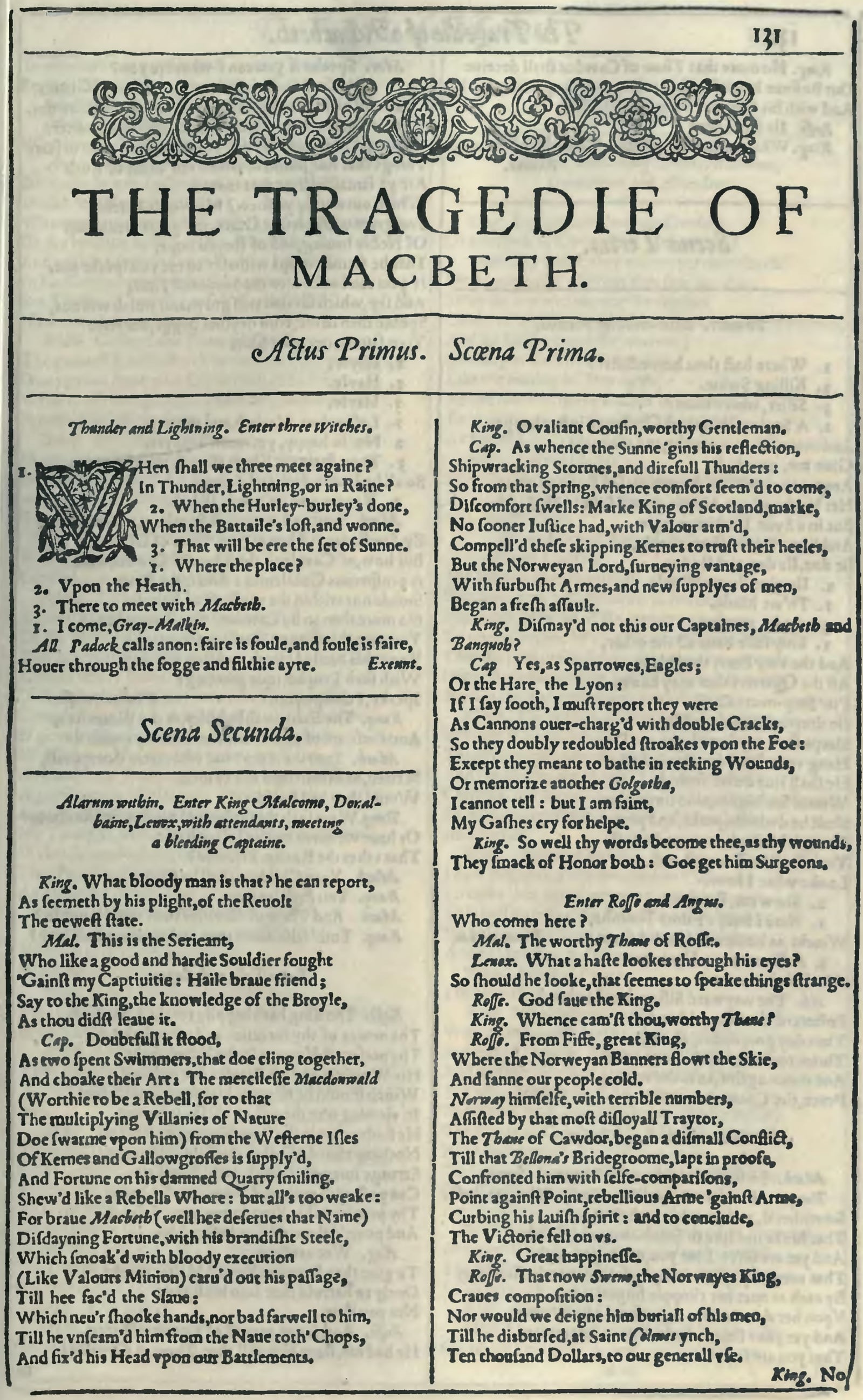
The first page of Macbeth in the First Folio, 1623.Isaac Jaggard and Edward Blount, printers, 1623. Wikimedia Commons. CC BY-SA 4.0.
Not in the source
Holinshed has no porter, no farmer and no equivocator.
The pro reading
The Porter mocks equivocation and treason, not the Mass. The horror at Duncan’s murder is sacramental (“The Lord’s anointed temple”, “our poisoned chalice”), and the one holy figure is Edward the Confessor, a canonised Catholic saint-king who cures “the evil” with “holy prayers” (4.3).
The sceptical reading
Henry Garnet, the Jesuit superior, was introduced at his trial on 28 March 1606 as “Farmer”, had written A Treatise of Equivocation, and was executed on 3 May 1606. The joke is at his expense weeks later. Edward flatters James I, who practised the touch himself, and the passage is in Holinshed.
Strongagainst a Jesuit-sympathising authorSuggestiveEdward the Confessor, at most
“Five fiends have been in Poor Tom at once: of lust, as Obidicut; Hobbididance, prince of dumbness; Mahu, of stealing; Modo, of murder; Flibbertigibbet, of mopping and mowing.”Edgar, 4.1
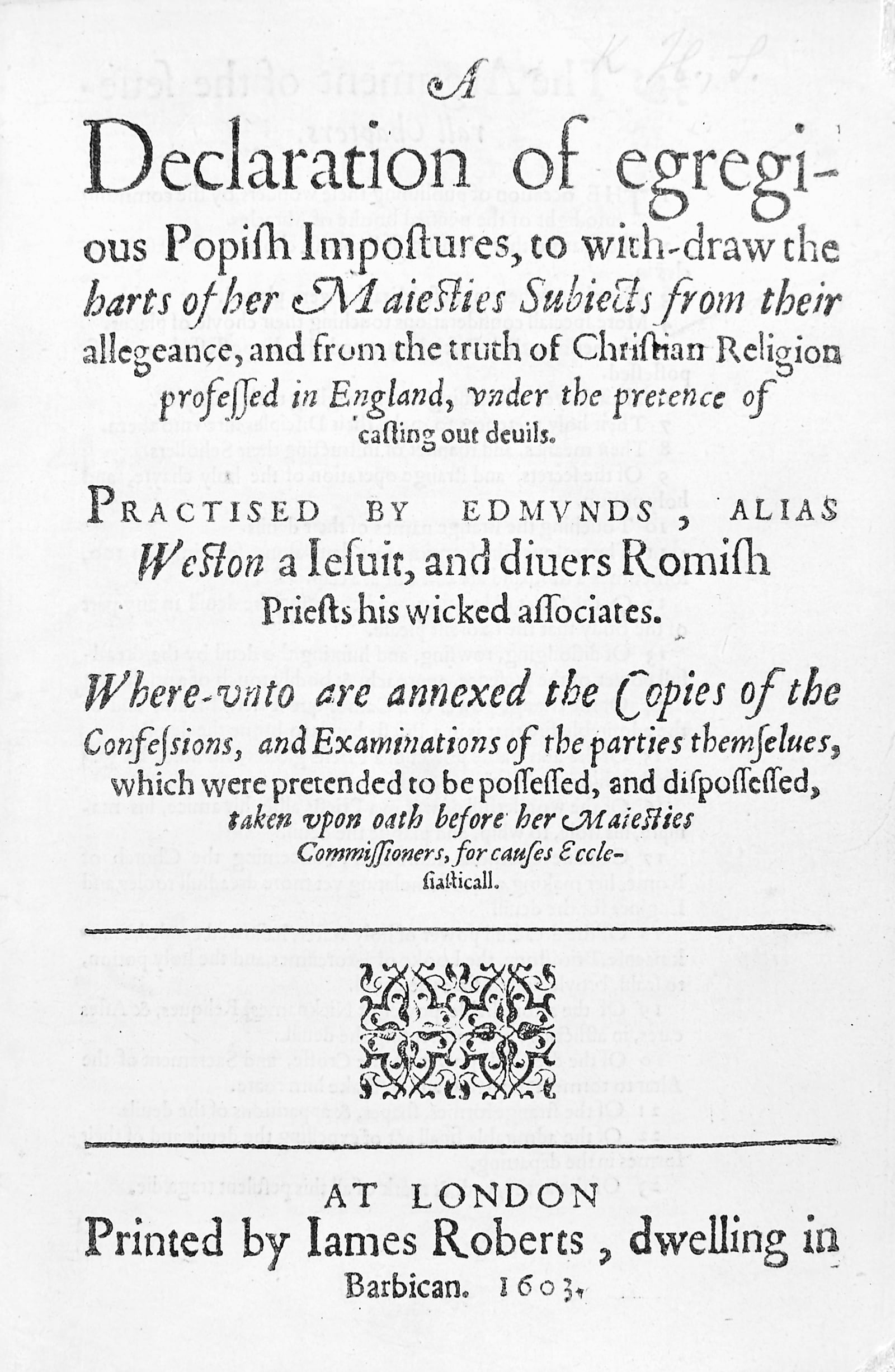
Harsnett’s Declaration of Egregious Popish Impostures, 1603, the Privy Council’s exposure of the Denham exorcisms. The devils’ names in King Lear come from it. Wellcome Collection.Printed by James Roberts, London; scan by the Wellcome Collection, 1603. Wikimedia Commons. CC BY 4.0.
Where it came from
Samuel Harsnett’s Declaration of Egregious Popish Impostures (1603), published by order of the Privy Council, exposed the Denham exorcisms of 1585 and 1586, with Robert Dibdale of Shottery among the exorcists. The devil names are his.
The pro reading
The “possessed” man is a wronged, virtuous son feigning. The only “miracle”, the Dover cliff, is a loving fraud that saves a despairing father. Cordelia’s “It is thy business that I go about” (4.4) is as close as the canon comes to Christ’s words about himself; Lear’s “Thou art a soul in bliss, but I am bound / Upon a wheel of fire” (4.7) gives the reunion the shape of a soul in Purgatory meeting a saint.
The sceptical reading
A sensational bestseller was an obvious source for the sound of a possessed beggar. The play hangs Cordelia and lets “The gods defend her!” be answered by her corpse. The pagan setting is in Holinshed. The Catholic allegory in which Edgar is the hunted recusant is unfalsifiable.
Neutralthe Harsnett borrowingsSuggestivethe framing of the possessed; Cordelia
“Then, Isabel, live chaste, and, brother, die. / More than our brother is our chastity.”Isabella, 2.4
Not in the source
Cinthio’s Epitia and Whetstone’s Promos and Cassandra have no novice, no Poor Clares and no disguised confessor.
The pro reading
Shakespeare added a novice of “the votarists of Saint Clare” (1.4), a Duke in a Franciscan habit who hears three auricular confessions and draws in Juliet’s (2.3) the scholastic distinction between sorrow from fear and sorrow from love of God, ending “Grace go with you. Benedicite”, and a villain marked as a Puritan: “Lord Angelo is precise” (1.3). Beauregard: Reformation drama cast friars and nuns as vow-breaking Vice figures, and Shakespeare inverts it; no religious figure is punished.
The sceptical reading
The Duke uses the seal of confession to run a plot and set up a bed trick. Kastan says friars in an Italianate setting are neutral furniture. The Jesuit censor at Valladolid physically cut the entire play out of the Second Folio.
Suggestivefor a sympathetic, un-satirical treatment of religious lifeNeutralthe vocabulary itself
“We still have known thee for a holy man.”The Prince, of Friar Lawrence, 5.3
What the source said
Arthur Brooke’s 1562 preface blames the lovers for consulting “superstitious friars (the naturally fit instruments of unchastity”.
The pro reading
Shakespeare makes the friar the moral centre and has the Prince vouch for him. Juliet asks whether to come “at evening Mass” (4.1), once cited as proof of Catholic ignorance, though afternoon Masses are documented in Verona.
The sceptical reading
Brooke’s friar is already a Franciscan who makes the potion. Bryant argued Shakespeare’s friar breaks canon law, teaches Juliet deceit and flees the tomb. Italian settings license friars.
“Where, meeting with an old religious man, / After some question with him, was converted / Both from his enterprise and from the world.”Jaques de Boys, 5.4
Not in the source
In Lodge’s Rosalynde the usurper is killed in battle. The hermit conversion is Shakespeare’s change.
The pro reading
The one clergyman mocked is the hedge-priest Sir Oliver Martext (3.3), whose name marks a Protestant preaching minister. Rosalind’s “as full of sanctity as the touch of holy bread” (3.4) was struck by the Valladolid censor.
The sceptical reading
Martext is mocked, but so is marriage. “Holy bread” is an idiom a conforming Englishman still used in the 1590s.
Suggestivethe hermit, as patternNeutralMartext, holy bread
“I am Saint Jaques’ pilgrim, thither gone. / Ambitious love hath so in me offended / That barefoot plod I the cold ground upon, / With sainted vow my faults to have amended.”Helena’s letter, 3.4
What the source had
Boccaccio’s Giletta does go on pilgrimage, so the device is source-given. The penitential wording is not.
The pro reading
Beauregard lists the penance and intercession lines here, and “the house with the narrow gate” (4.5), among his Rheims-flavoured allusions.
The sceptical reading
Pilgrimage was a romance convention before it was a confessional marker.
“Dost thou think, because thou art virtuous, there shall be no more cakes and ale?”Sir Toby, 2.3
The frame
The title is the Eve of Epiphany, a holiday Puritans opposed. Maria: “sometimes he is a kind of puritan.” Feste as Sir Topas performs a mock exorcism on Malvolio (4.2).
The pro reading
The one religious type satirised is the Puritan. Jensen’s “festive traditionalist” aligns the comedies with the saints’-day culture reformers had marked as popish.
The sceptical reading
The Elizabethan conformist majority also kept Christmas and disliked Puritans. The mock exorcism mocks exorcism too. Jensen herself says the alignment is aesthetic, not theological.
“Tell him this tale, and from the mouth of England / Add thus much more, that no Italian priest / Shall tithe or toll in our dominions.”King John, 3.1
What he kept and what he cut
He kept the king’s attack on kings who “Purchase corrupted pardon of a man / Who in that sale sells pardon from himself” (3.1). He cut the source play’s friars, hidden nun, the monk shown plotting with his abbot, and John’s dying prophecy of a king who would “tread down the strumpet’s pride / That sits upon the chair of Babylon”. The poisoning is reported offstage with no motive.
The pro reading
The lines go to a king the play then shows surrendering his crown to the legate and dying poisoned, with Pandulph alive and brokering peace in the last scene. Colley Cibber in 1745 complained the play lacked the source’s anti-Catholic fire.
The sceptical reading
Cibber then decided no Catholic could have written the pardon lines. The ISE survey records that arguments for Catholic sympathy are “in the minority”. The ending, “If England to itself do rest but true”, is nationalist, not confessional.
Strongagainst, with a real counterSuggestivethe cuts
“Five hundred poor I have in yearly pay / Who twice a day their withered hands hold up / Toward heaven to pardon blood. And I have built / Two chantries where the sad and solemn priests / Sing still for Richard’s soul.”Henry, 4.1
Where it came from
The chantries and the almsmen are in Holinshed.
The pro reading
The most Catholic-sounding passage in the histories, written with feeling: the whole machinery of intercession for the dead.
The sceptical reading
Henry’s own coda: “all that I can do is nothing worth, / Since that my penitence comes after all.” The same scene has him tell Williams that “every subject’s soul is his own” and that a soldier should prepare like “every sick man in his bed”, the Protestant logic of private conscience.
“Oldcastle died a martyr, and this is not the man.”Epilogue, 2 Henry IV
The facts
Falstaff was first named for Sir John Oldcastle, the Lollard knight Foxe gave a woodcut. Traces survive: “my old lad of the castle” (1 Henry IV 1.2) and a speech prefix “Old.” in the 1600 quarto. Pressure from the Cobhams, who held the Lord Chamberlain’s office, produced the change.
The pro reading
John Speed in 1611 accused Shakespeare of satirising a proto-Protestant martyr.
The sceptical reading
Kastan: a contemporary audience read the mockery of Lollardy as a jab at Puritans, inside Protestant culture. Henry Brooke, the 11th Baron, was himself sympathetic to Catholicism, so the Cobhams were not Protestant heroes.
Strongas a censorship factNeutralas Catholic evidence
“I’ll give my jewels for a set of beads, / My gorgeous palace for a hermitage, / My gay apparel for an almsman’s gown, / My figured goblets for a dish of wood, / My scepter for a palmer’s walking-staff, / My subjects for a pair of carvèd saints.”Richard, 3.3
The frame
“Not all the water in the rough rude sea / Can wash the balm off from an anointed king” (3.2). Carlisle’s “field of Golgotha” (4.1).
The pro reading
Sacramental kingship imagined with feeling; a catalogue of old-religion objects spoken with longing.
The sceptical reading
It is put in the mouths of a bishop who is arrested and a king who loses. Both confessions believed in anointed kings.
“I do refuse you for my judge, and here, / Before you all, appeal unto the Pope.”Katherine, 2.4 (Shakespeare’s scene)
The authorship split
Shakespeare wrote Katherine’s trial (2.4). Fletcher wrote her vision of angels (4.2) and Cranmer’s prophecy that “God shall be truly known”, which ends the play on a Protestant baptism.
The pro reading
The Catholic queen gets the play’s moral centre. The Valladolid censor cut Cranmer’s Marian imagery and left Katherine alone: Katherine was theirs, Cranmer was not.
The sceptical reading
Neither scene can be hung on Shakespeare alone.
SuggestiveKatherineStrongCranmer’s finale as Protestant, and Fletcher’s
“It is required / You do awake your faith.”Paulina, 5.3
Not in the source
Greene’s queen dies. The statue scene is Shakespeare’s.
The pro reading
Set in a “chapel”; Perdita kneels and says “do not say ’tis superstition”; Paulina disclaims “wicked powers”; Leontes calls the result “an art / Lawful as eating”. Every phrase is the vocabulary of the Elizabethan quarrel over images, and the scene stages an image doing what Protestant polemic said images could not.
The sceptical reading
The god is Apollo and the frame is Pygmalion. Diehl, Goldman and Jensen read it as Protestant wonder or iconoclasm turning on itself.
“The rarer action is / In virtue than in vengeance. They being penitent, / The sole drift of my purpose doth extend / Not a frown further.”Prospero, 5.1
The Epilogue
“Prayer”, “mercy”, “frees all faults”, “as you from crimes would pardoned be”, and “indulgence” cluster densely.
The pro reading
Intercession and indulgence vocabulary, denser than convention requires.
The sceptical reading
“Indulgence” meant kindness. Epilogue pleas were conventional. The logic is the Lord’s Prayer, common to both confessions. So far as the catalogue records, the Valladolid censor left the Epilogue alone and cut only bawdry.
“Bare ruined choirs, where late the sweet birds sang.”Sonnet 73
73
Universally glossed as the dissolved monasteries; no major editor treats it as a confession. A Protestant Englishman in 1600 walked past the same ruins.
124
“The fools of time, / Which die for goodness, who have lived for crime.” Klause reads executed Jesuits; Rowse and Hotson read it as anti-Jesuit; the variorum calls the couplet “hopelessly obscure”. A genuine open crux.
105 and 125
The defence against “idolatry” (I worship one, not many) is the position Protestants recognised as their own. 125’s “oblation, poor but free” and “suborned informer” are the sequence’s densest sacramental vocabulary: texture, not evidence.
Suggestive73, as textureNeutral124 in net; 105 and 125
“Death is now the Phoenix’ nest, / And the Turtle’s loyal breast / To eternity doth rest, / Leaving no posterity: / ’Twas not their infirmity, / It was married chastity.”Threnos, 1601
The thesis
Clara Longworth de Chambrun (1935), then Finnis and Martin (TLS, 18 April 2003): a secret requiem for Anne Line, hanged at Tyburn on 27 February 1601 after a Candlemas Mass raid, and her exiled husband Roger, with the “bird of loudest lay” as William Byrd.
For it
The requiem structure, the married chaste dead, the date.
Against it
The surplice is Protestant vesture. The Lines had a son. Roger died about 1594, seven years before Anne, so they did not die together. The volume honours the Protestant courtier Sir John Salusbury. Duncan-Jones found the story very moving but said she “cannot believe” the lyric alludes to it. The Folger says such identifications are “no longer widely favored”.
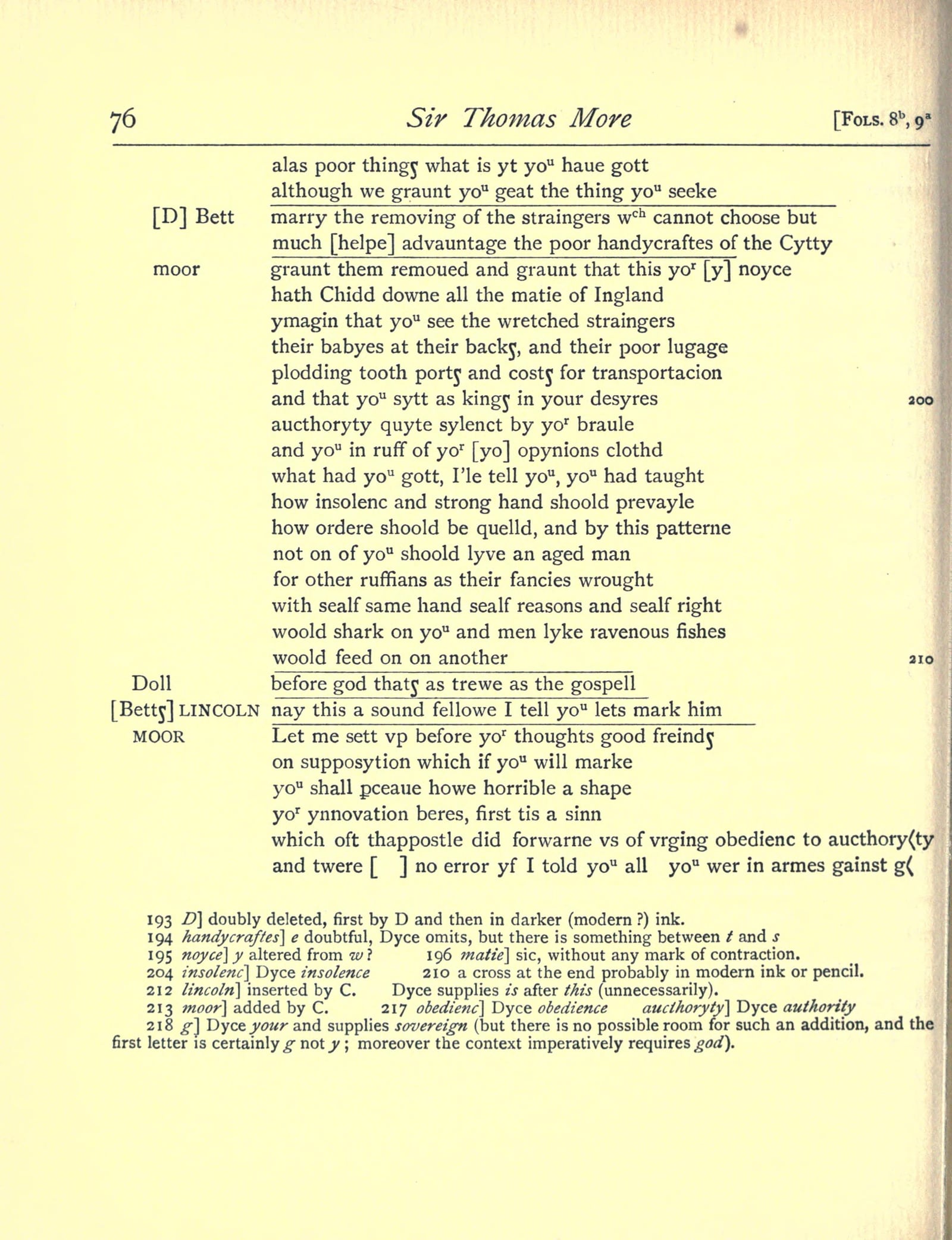
“ymagin that you see the wretched straingers / their babyes at their backs, and their poor lugage / plodding tooth ports and costs for transportacion”Addition II, Hand D, Harley MS 7368 (Greg’s diplomatic text)
Greg, The Book of Sir Thomas More, 1911, page 76: the Hand D addition in diplomatic transcript, with “ymagin that you see the wretched straingers”.W. W. Greg (editor), 1911. Internet Archive. Public domain.
The facts
Three pages in a collaborative manuscript, “probably” Shakespeare’s hand; the attribution has been generally accepted since the mid-twentieth century, with Hays (2016) and Werstine dissenting. The speech is about riot, obedience and the stranger. The play never names what More died for.
The pro reading
He wrote for a sympathetic play about a Catholic martyr.
The sceptical reading
The lead author, Munday, had hunted Campion. It is an order-and-obedience speech the 1571 Homily against rebellion would endorse.
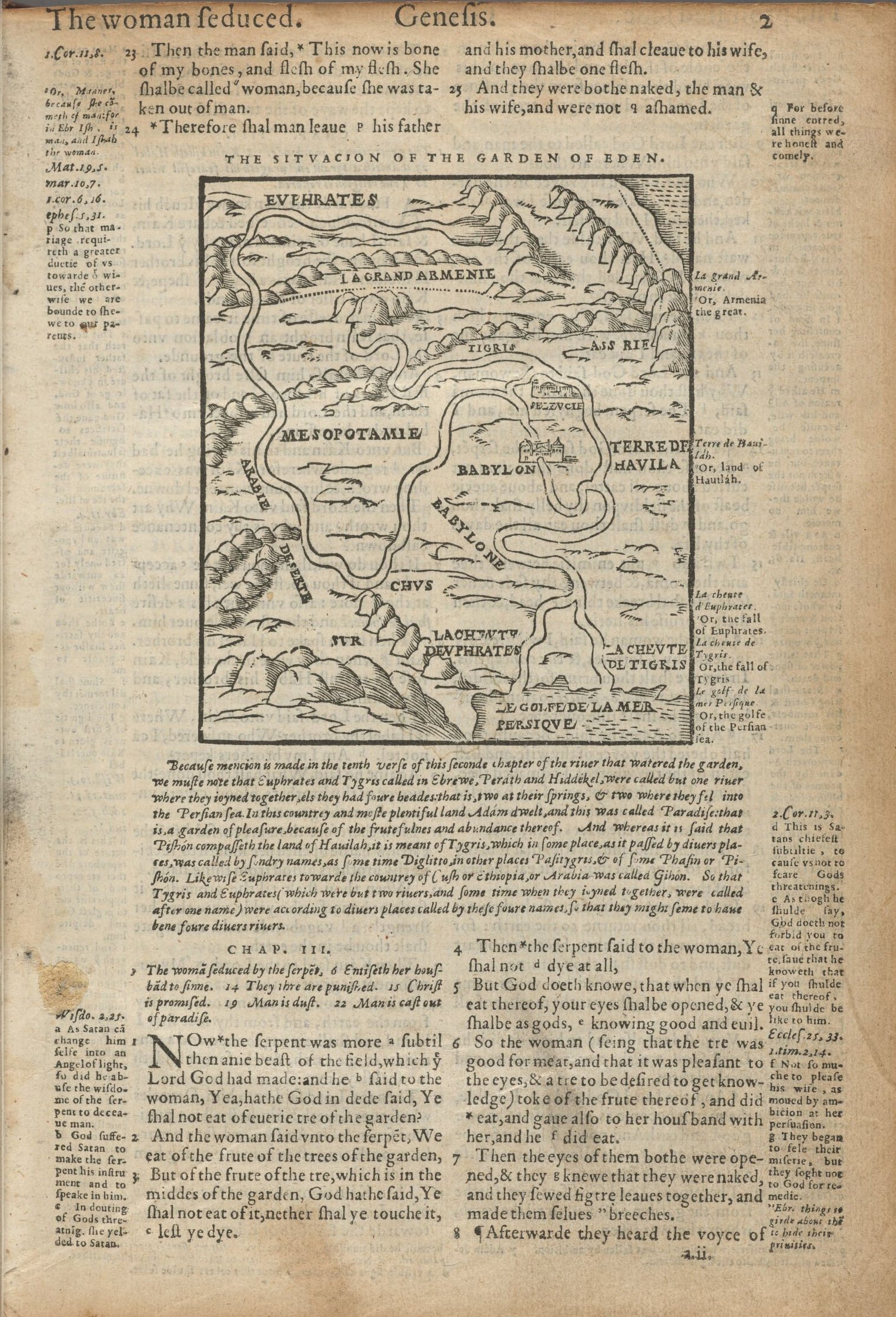
“edified by the margent”Horatio, Hamlet 5.2, on the Geneva Bible’s marginal notes
The Geneva Bible, 1560, with its marginal notes: Horatio’s margent. Houghton Library copy.Printed by Rowland Hall, Geneva; scan by the Houghton Library, 1560. Wikimedia Commons. Public domain.
The count
Shaheen puts the Geneva Bible first and the Bishops’ second across the canon, with the Prayer Book Psalter supplying the Psalms: 14 Geneva readings in the tragedies and 10 in the histories against 11 from all other versions combined. Noble (1935) and Hamlin (2013) agree on the Protestant texture.
The reply
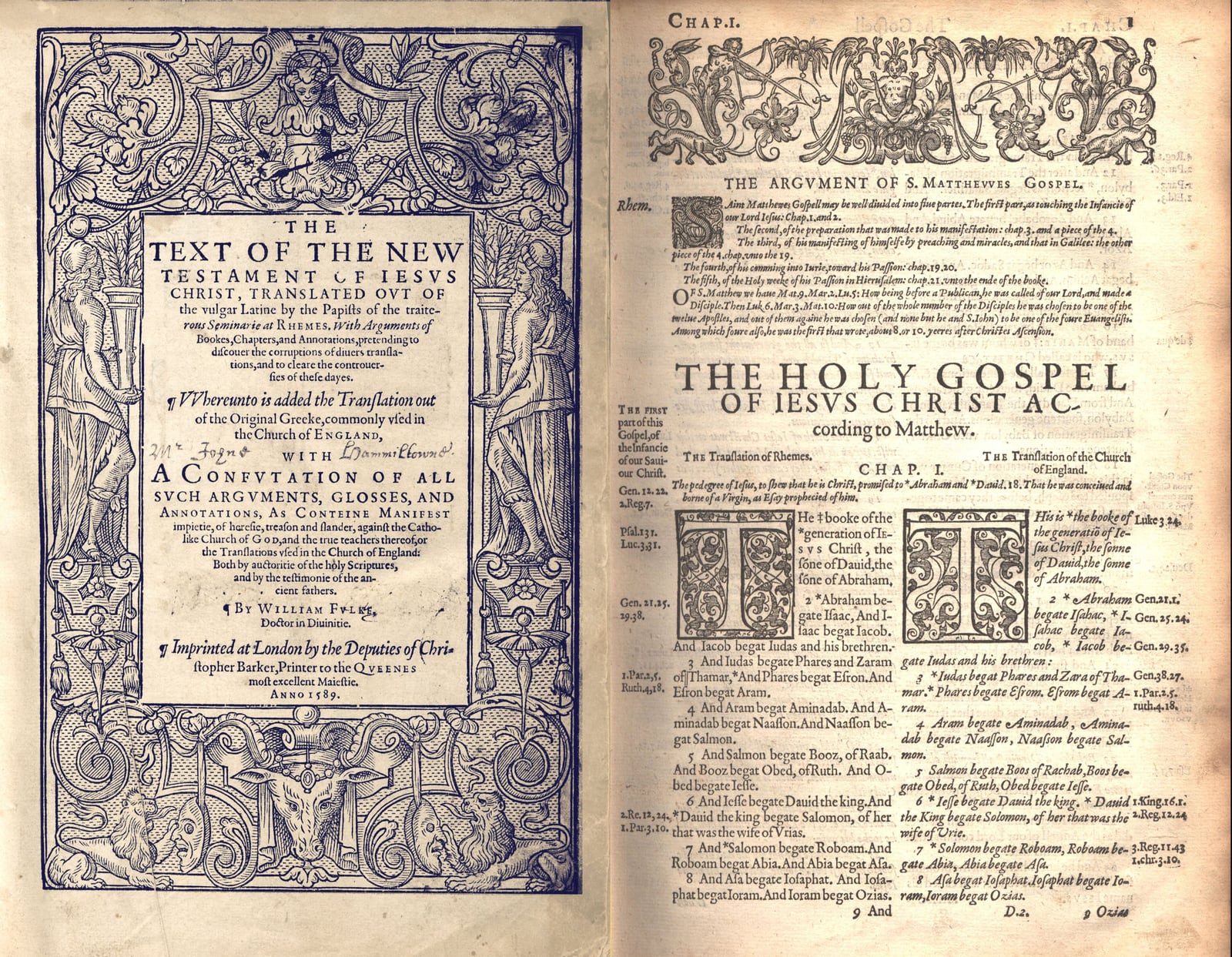
Beauregard counts roughly fifty possible Rheims echoes (“do penance”, sacramental “confess”, “Revenge to me”) against about thirty Geneva ones, proposes Fulke’s 1589 parallel edition as the channel, and concedes that few are certain and that “his personal faith cannot be determined from these allusions”.
Strongfor Protestant formation of reading habits; does not reach belief
“She must, the saints must have her; yet a virgin”What the Valladolid censor left of Cranmer’s praise of Elizabeth, Henry VIII
Fulke’s hostile parallel edition of 1589, which set the Rheims text beside the Bishops’ Bible and made it widely available.William Fulke, editor; printed by the deputies of Christopher Barker, 1589. Wikimedia Commons. Public domain.
Valladolid
At the English College of St Alban’s a Jesuit censor, conventionally William Sankey, working some time after 1641, excised Measure for Measure entirely from a Second Folio, inked out bawdry and oaths across the volume, blacked out the monk poisoning the king in King John while leaving the “Italian priest” speech alone, and cut Cranmer’s Marian-coloured praise while leaving Katherine. More than half the plays are untouched.
Saint-Omer
A First Folio found in 2014 at the English Jesuit college carries annotations for schoolboy performance, turning Mistress Quickly into a “host” so boys need not play women.
Douai
In 1694 and 1695 an exile community copied six plays from the Second Folio, lightly expurgated, probably for private performance.
Neutralas evidence about the authorStrongas evidence of Catholic affection for the plays