Master Timeline
1517 to 1646, then the afterlife of the documents. Where the notes flag a dispute, it is flagged here.
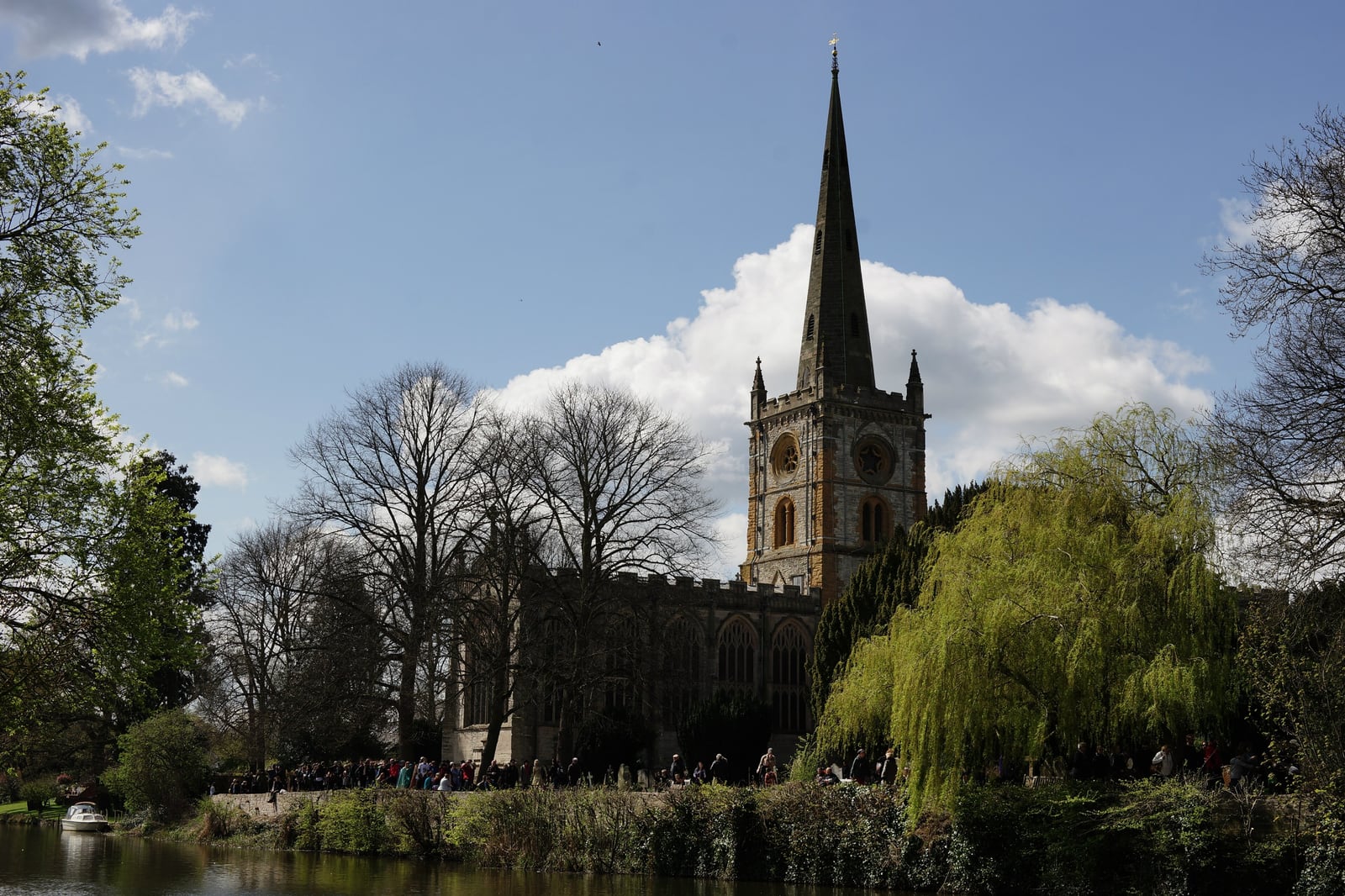
- 1517
Robert Arden joins Stratford’s Guild of the Holy Cross.
- 1547
The Chantries Act ends 2,374 chantries and guild chapels. Stratford’s guild is dissolved; its members re-emerge in 1553 as the Corporation.
- 1556
Robert Arden’s will, 24 November, with a preamble Lee called that of “an observant Catholic”; proved 16 December. John Shakespeare becomes ale-taster.
- 1559
The Acts of Supremacy and Uniformity.
- 1563/64
As chamberlain John records 2s for “defasyng ymages in ye chapell”; the next year 2s for taking down the rood loft.
- 1564
William baptised 26 April at Holy Trinity. “Hic incepit pestis” beside a burial that June.
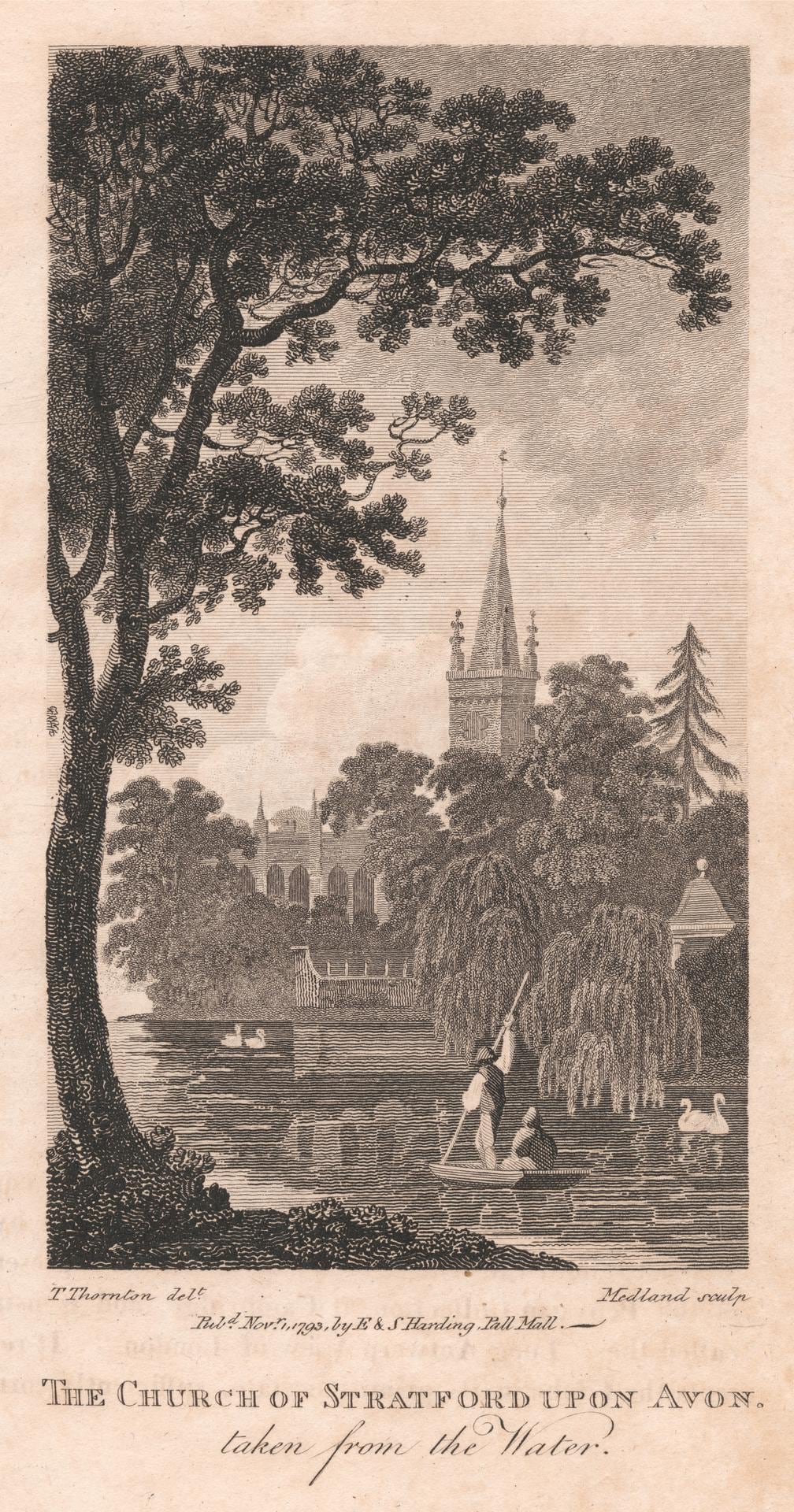
Holy Trinity Church from the water, engraved by Thomas Medland after T. Thornton, 1793.Thomas Medland, after T. Thornton; scan by the Yale Center for British Art, 1793. Wikimedia Commons. CC0. - 1568
John sworn bailiff and justice, 1 October.
- 1570
Regnans in Excelsis.
- 1571
Treasons Acts. Simon Hunt master at the school until 1575.
- 1577
John stops attending the council. Exchequer informer cases have run since 1569.
- 1578
John excused the poor rate, 19 November; Asbies mortgaged to Edmund Lambert for £40, 14 November.
- 1580
Campion lands at Dover, 24 June. John fined £40 in Queen’s Bench, half of it as surety for a Nottingham hatter.
- 1581
The Act with the £20 fine, 18 March. Alexander Hoghton’s will names William Shakeshafte, 3 August. Campion executed at Tyburn, 1 December.
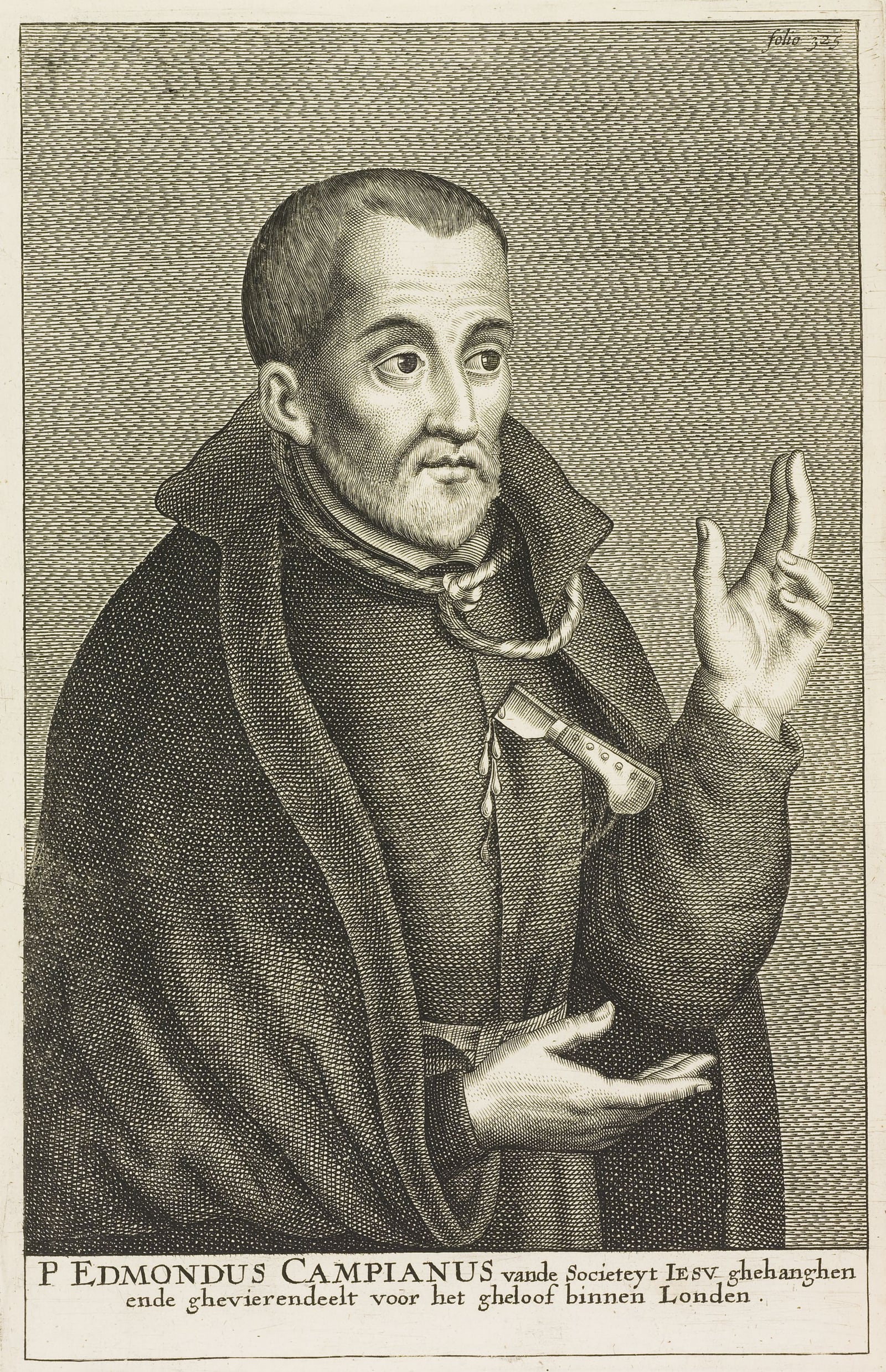
Edmund Campion, in a seventeenth-century engraving. Landed at Dover 24 June 1580; executed at Tyburn 1 December 1581.Unknown engraver, seventeenth century. Wikimedia Commons. Public domain. - 1582
Thomas Cottam executed, 30 May. Marriage licence at Worcester, 27 November, naming “Annam Whateley de Temple grafton”; bond next day for Anne Hathwey of Stratford.
- 1583
Susanna baptised 26 May. Edward Arden executed at Smithfield, 20 December. Disputed: The Catholic Encyclopedia gives 30 December, and the DNB wrongly says Tyburn in October. Nearly every other source gives 20 December.
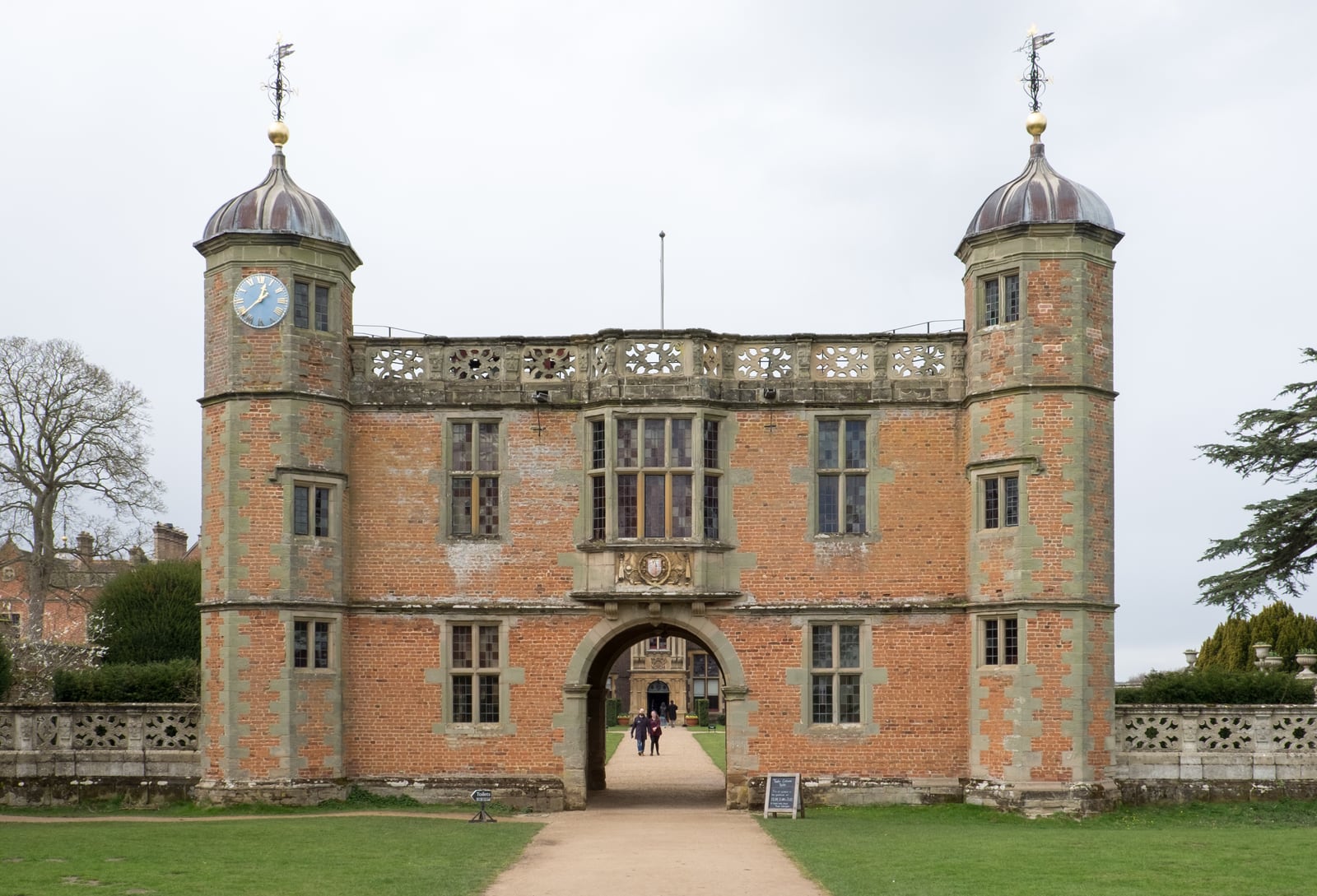
The gatehouse of Charlecote Park, Sir Thomas Lucy’s house. Lucy searched the Arden houses in 1583; the deer-poaching story in Davies’s note is set here.DeFacto, 2016-04-09. Wikimedia Commons. CC BY-SA 4.0. - 1585
Hamnet and Judith baptised 2 February. The Act against Jesuits and seminary priests.
- 1586
Robert Dibdale of Shottery executed at Tyburn, 8 October. John removed as alderman, 6 September. Cartwright preaches in Stratford.
- 1592
The Warwickshire certificate, 25 September: John among nine who “come not to church for fear of process for debt”.
- 1593
Venus and Adonis, printed by Richard Field, dedicated to Southampton.
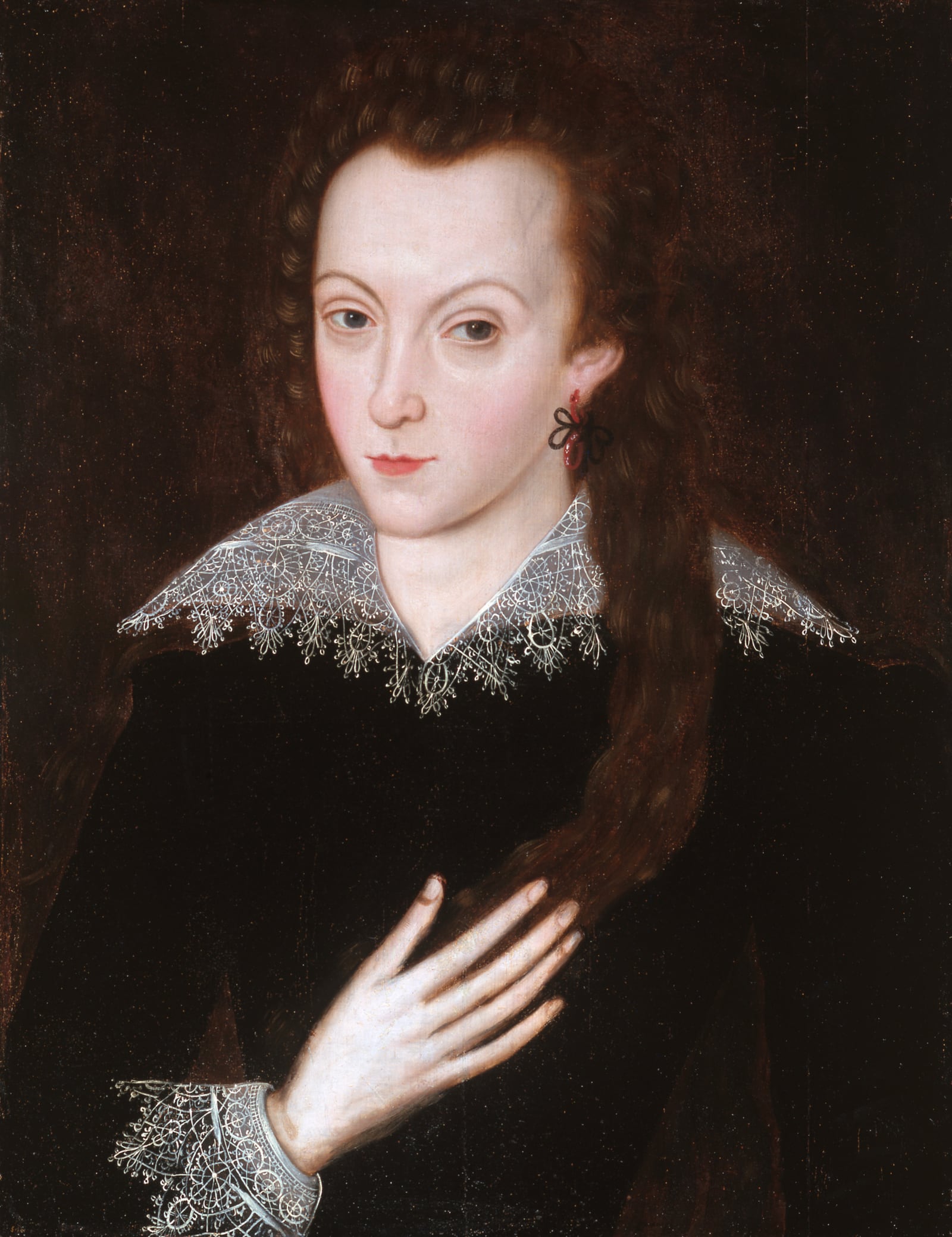
Henry Wriothesley, third Earl of Southampton, in the 1590s. Venus and Adonis was dedicated to him in 1593.Attributed to John de Critz; photograph of the Cobbe Collection portrait, about 1590 to 1600. Wikimedia Commons. CC BY-SA 3.0. - 1595
Southwell executed at Tyburn, 21 February.
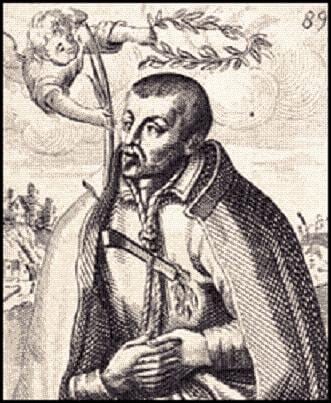
Robert Southwell, Jesuit and poet, executed at Tyburn 21 February 1595. Period engraving.Unknown engraver, sixteenth or seventeenth century. Wikimedia Commons. Public domain. - 1596
Hamnet buried 11 August. Dethick drafts the grant of arms for John, 20 October.
- 1599
The arms exemplified with the Arden impalement; the Park Hall coat drawn and struck out.
- 1601
Richard II revived for Essex’s followers, 7 February; the rising next day. Anne Line hanged, 27 February. John Shakespeare dies.
- 1603
James accedes. Harsnett’s Declaration of Egregious Popish Impostures.
- 1604
The Hampton Court Conference, January, a Puritan and bishops affair. Sugar and Grissold executed at Warwick, 16 July.
- 1605
The Gunpowder Plot. Rookwood at Clopton House; arms at Norbrook; the plotters’ families at Coughton.
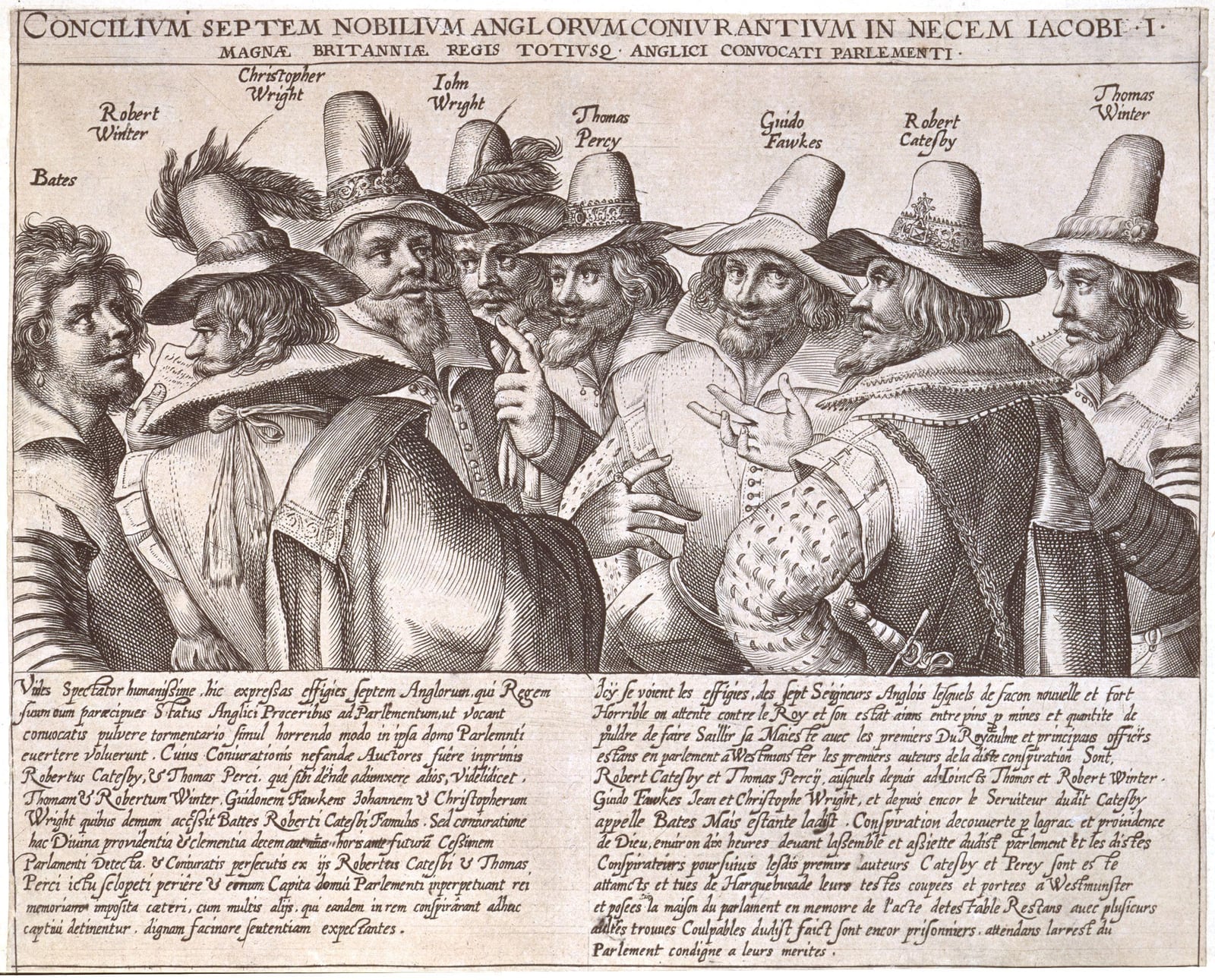
The Gunpowder plotters, engraved by Crispijn van de Passe the Elder, 1605: Bates, Robert Wintour, the Wrights, Percy, Fawkes, Catesby, Thomas Wintour.Crispijn van de Passe the Elder, 1605. Wikimedia Commons. Public domain. - 1606
Owen dies under torture, 1 to 2 March. Garnet tried 28 March, executed 3 May. Susanna cited 5 May for not receiving Easter communion. Jonson and his wife cited in January before the London Consistory Court.
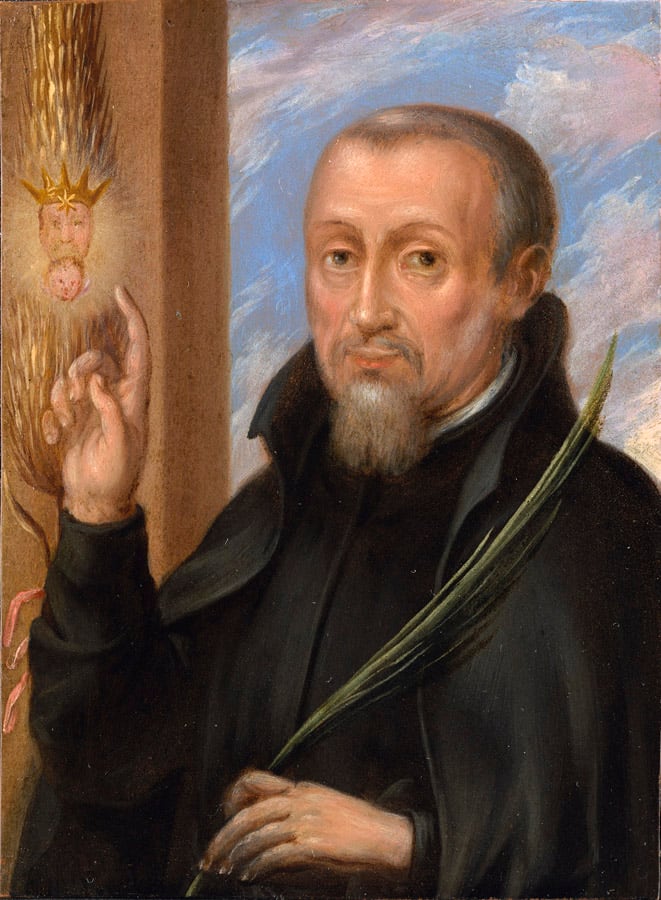
Henry Garnet, superior of the Jesuits in England, tried as Farmer on 28 March 1606 and executed 3 May 1606. Anonymous seventeenth-century painting.Anonymous, European school, seventeenth century. Wikimedia Commons. Public domain. - 1608
Mary Shakespeare buried 9 September. William stands godfather to Henry Walker’s child.
- 1613
The Blackfriars Gatehouse bought, 10 March. The Globe burns during Henry VIII, 29 June. William Reynolds jailed for recusancy in the autumn.
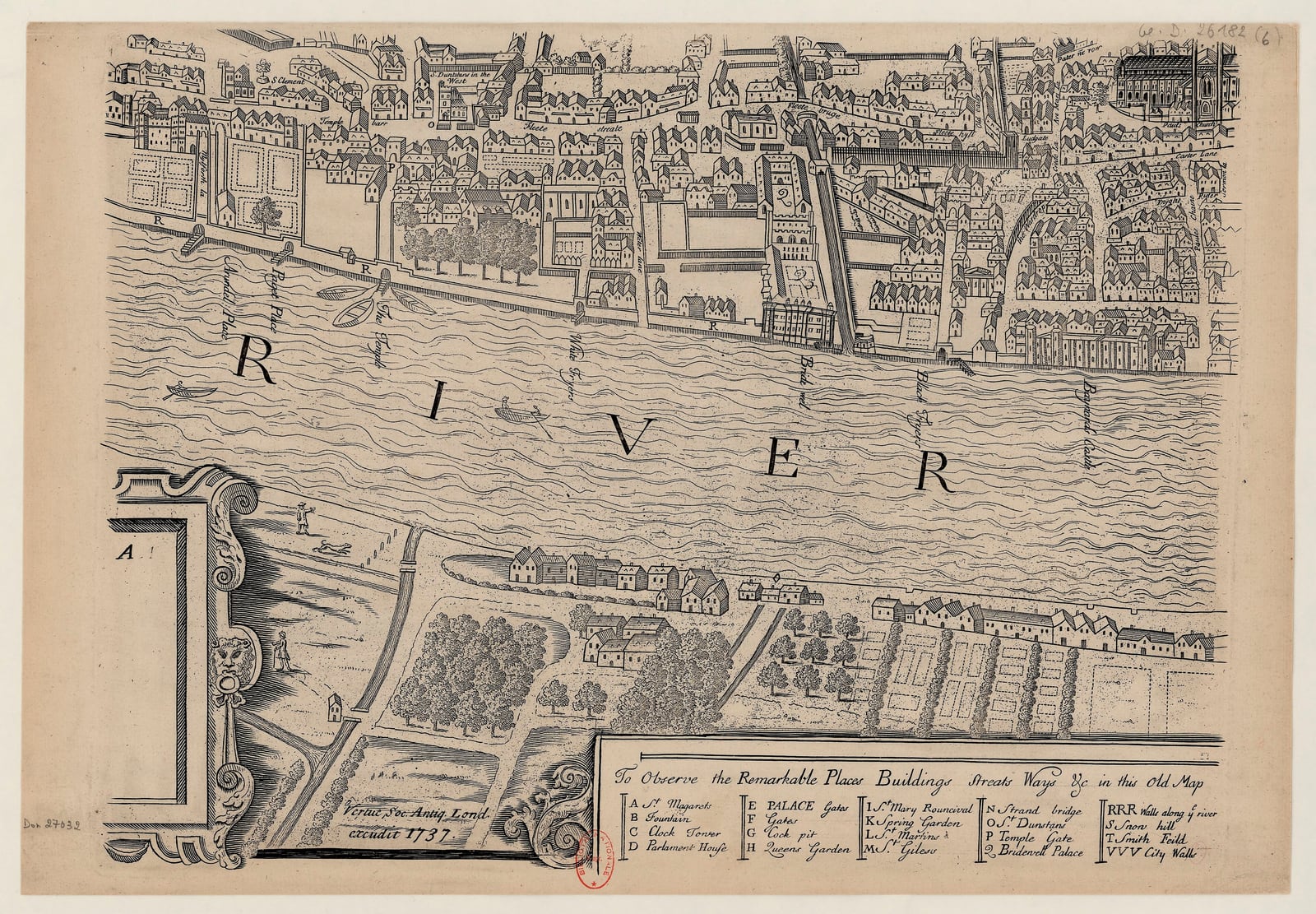
Blackfriars on the Agas map, Civitas Londinum, about 1561, in George Vertue’s 1737 impression. Bibliothèque nationale de France.George Vertue, after the map attributed to Ralph Agas; scan by the Bibliothèque nationale de France, 1737 impression of a map of about 1561. Wikimedia Commons. Public domain. - 1616
Will re-signed 25 March. William Hart buried 17 April. William Shakespeare dies 23 April, buried 25 April. Joan a widow in the Henley Street cottage.
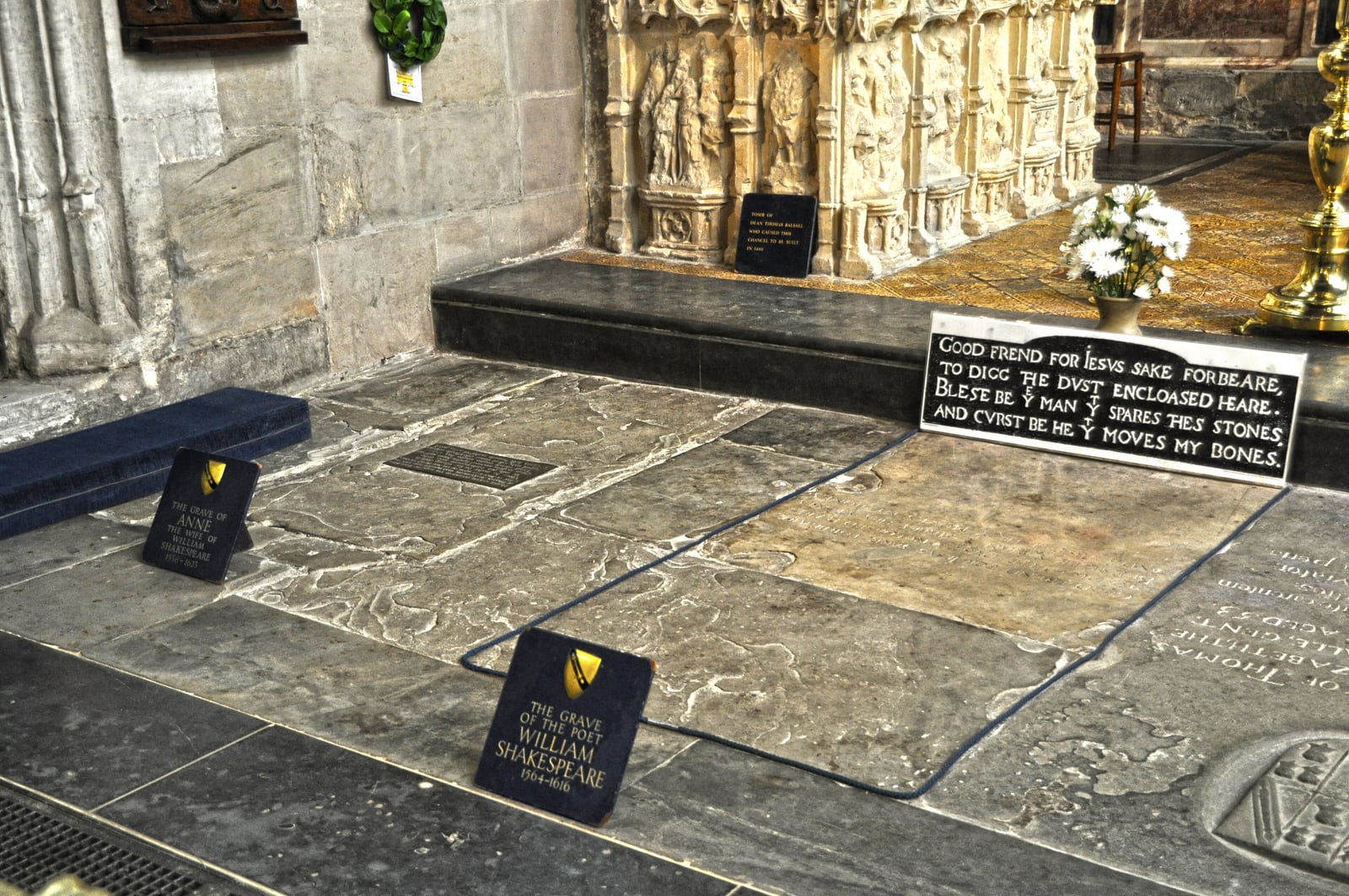
Shakespeare’s grave in the chancel of Holy Trinity, with the transcription of the four-line curse that Davies’s note mentions: Good frend for Iesvs sake forbeare.Lewis Clarke, 2014-05-04. Wikimedia Commons. CC BY-SA 2.0. - 1623
The First Folio.
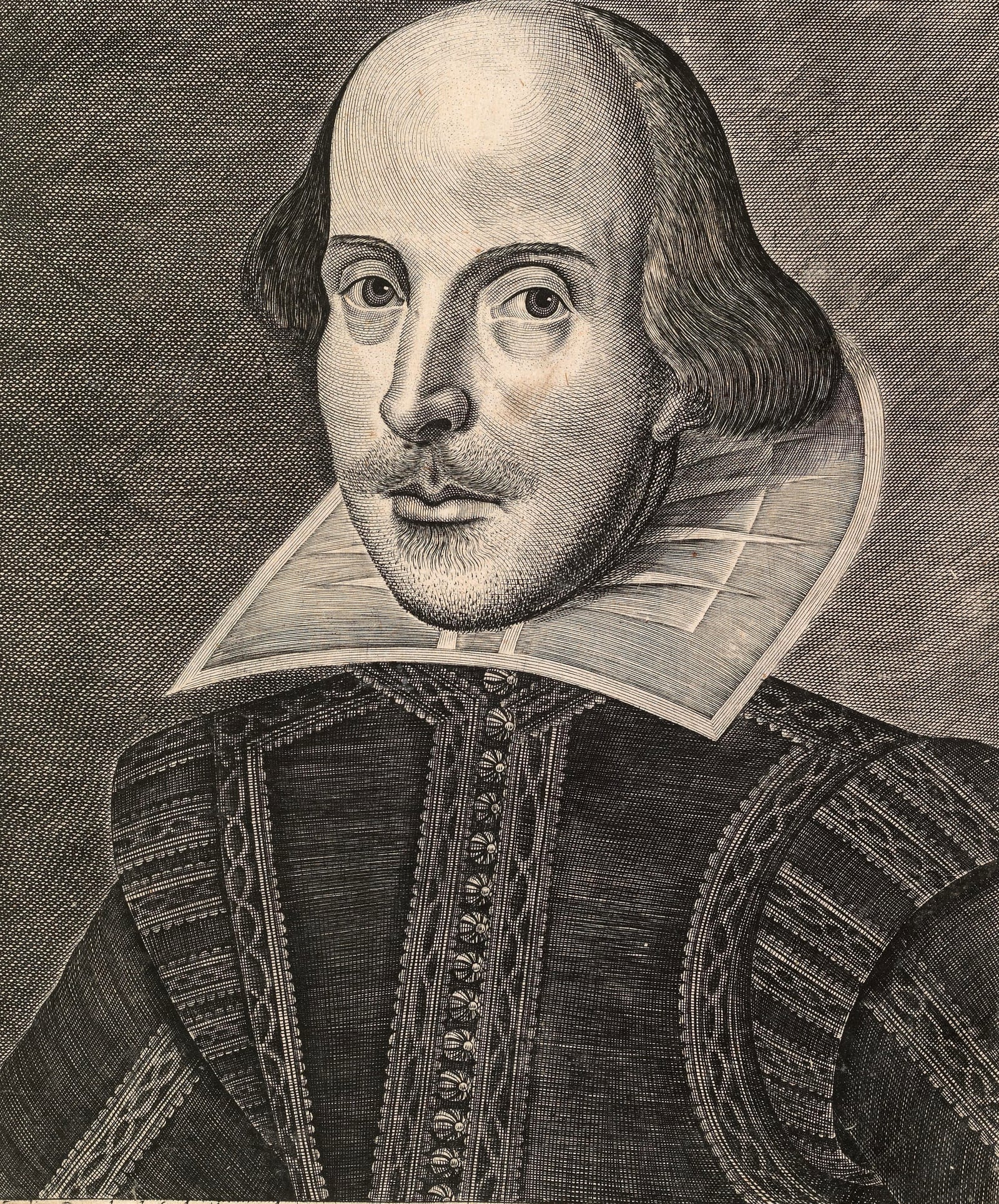
The Droeshout engraving, First Folio, 1623. Bodleian Library copy.Martin Droeshout; scan by the Bodleian Library, 1623. Wikimedia Commons. Public domain. - 1646
Joan Hart buried 4 November, aged 77.
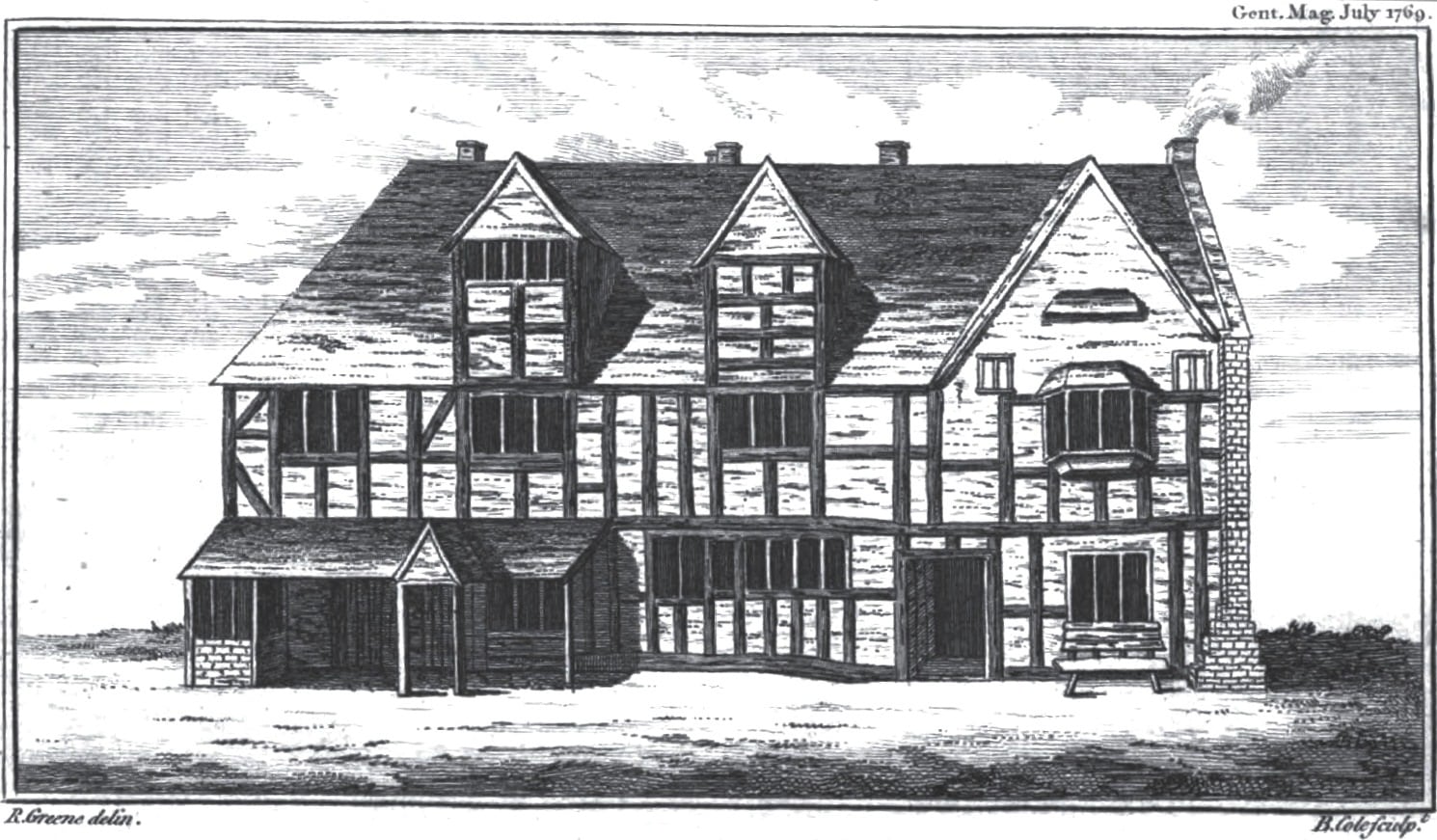
The Henley Street houses in 1769, drawn by Richard Greene and engraved by Benjamin Cole for the Gentleman’s Magazine: the earliest printed view, showing the main house and the western cottage as separate fronts before the restoration.Drawn by Richard Greene, engraved by Benjamin Cole, for the Gentleman's Magazine, 1769. Wikimedia Commons. Public domain.
- 1690s
Davies writes “He dyed a papist” into Fulman’s papers.
- 1757
Joseph Mosely, re-tiling the western Henley Street house, finds a booklet between rafters and tiles. Disputed: 1757 is Jordan’s date, attached to the lost first leaf. Malone’s own estimate was “about twenty years” before 1789, so about 1770.
- 1784
Jordan sends a copy to the Gentleman’s Magazine, 14 June; it is rejected as spurious.
- 1789
The original reaches Malone through Payton and the vicar Davenport.
- 1790
Malone prints the Testament. Jordan admits, 19 March, that the copy of the first leaf was his own.
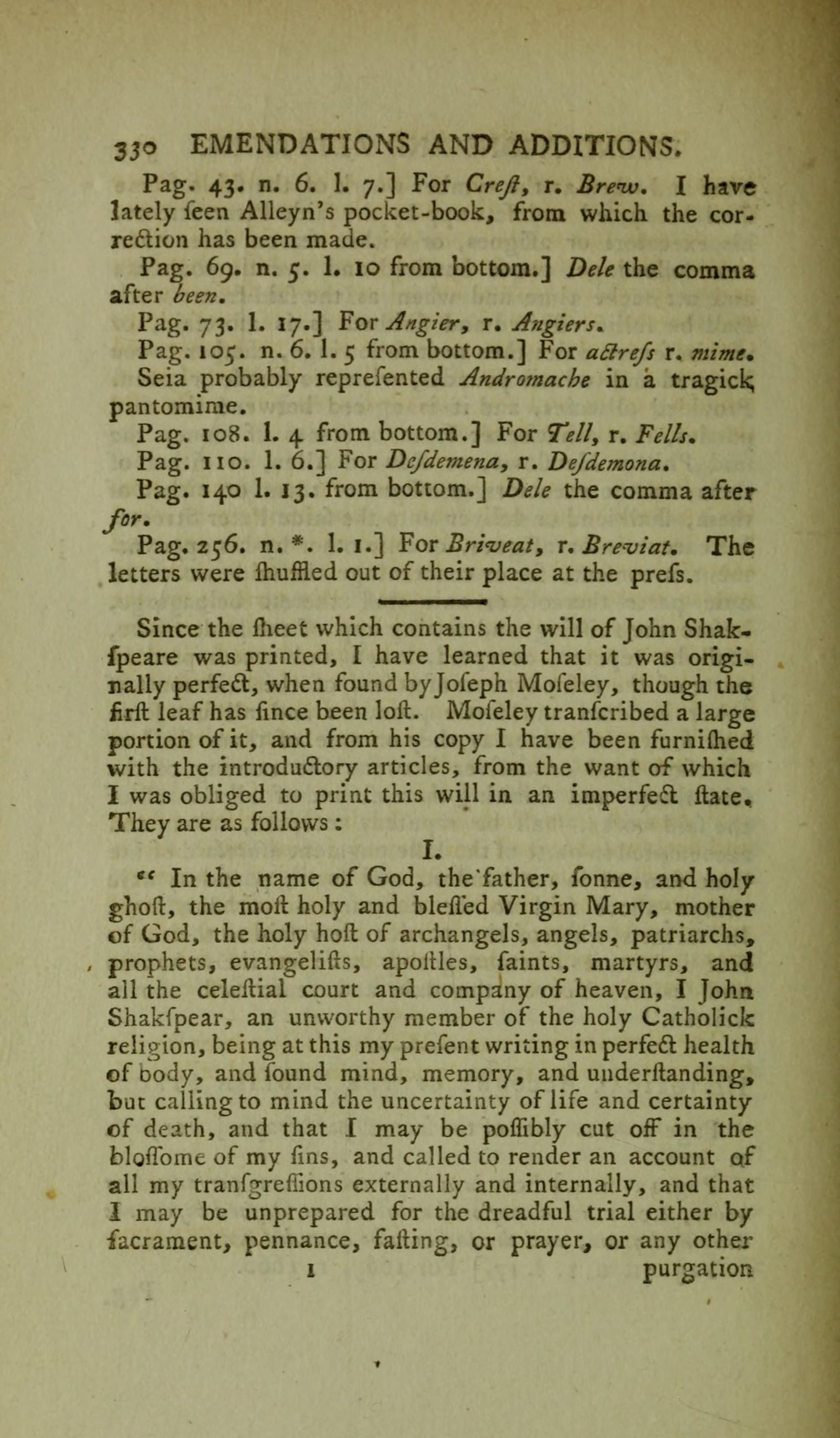
Malone, 1790, page 330: Articles I and II, printed from the copy John Jordan supplied. Malone never saw this leaf.Edmond Malone, 1790. Internet Archive. Public domain. - 1796
Malone’s retraction: documents prove it “could not have been the composition of any one of our poet’s family”. He never said forgery.
- 1923
Thurston finds the body of the text in a Borromeo-attributed edition printed at Mexico City in 1661.
- 1967
McManaway identifies the English printing, The Contract and Testament of the Soule (Saint-Omer, 1638), now at the Folger.
- 2003
Bearman’s reappraisal in Shakespeare Survey 56.
- 2024
Steggle: Venice, 1613; probably Joan’s.
Sources: as cited in the sections above, plus Shakespeare Documented, baptism; Shakespeare Documented, twins; Shakespeare Documented, 1586 removal; Shakespeare Documented, 1596 draft; Shakespeare Documented, burial; Wikipedia, Essex’s Rebellion; Wikipedia, Hampton Court Conference; Catholic Encyclopedia, Edward Arden; Bowden 1899; Chambers 1930.